A Landscape of Liminality
The Hill of Faughart is a site of ancient ruins, epic battles, long-buried kings, of saints and stories and legends. It is also place of great beauty. It is somewhere I have wanted to visit for a very long time but never did, even though it lies only an hour’s drive from where I live.
It is also said to be the birthplace of Brigid.

A week or so ago, my husband and I went on a whistlestop daytrip following the trail of the Táin bo Cuailnge. We made two detours: firstly to Foughart, and secondly to St. Mary’s Church at Templetown, a site associated with the Knights Templar. More about that in the weeks to come.
Now, before I go any further, let me just say there has been an explosion of writing about Brigid recently, and it is a joy to see how her spirit, her fiery arrow of Imbas is hitting its mark, burning into the collective consciousness, taking hold and driving momentum.
However, if you are interested in my thoughts on Brigid, you can find them in my previous essays that I will link to throughout this post.
Faughart, (pronounced something like Faw-hurt) is in County Louth, not far from the town of Dundalk. It consists of a typically circular early medieval ecclesiastical enclosure containing a church and graveyard. There is also a holy well and various other structures associated with Brigid, who was said to have been born here in 451 AD. In fact, a sign on the wall of the little ruined church claims that the very flagstone upon which she was born is still located at the site.


“on the morrow, at sunrise, when the bondmaid was going with a vessel of milk in her hand, and when she put one foot over the threshold of the house inside and the other foot outside, then did she bring forth the girl, to wit, Saint Brigit… On a Wednesday and on the eighth of the lunar month was Brigit born in Fothart Murthemni. Still, to the south-east of the church is the flagstone where Brigit was born.” 1
The Life of Brigid, Celt UCC
Looking out over a stunning view over the beautiful plains of Muirthemne – Cúchulainn’s country – is Brigid’s holy well. A stone staircase leads down to the water, which is covered with a corbelled stone canopy that dates to between 1900 and 1924. It’s dark, and on the day we visited, the water was still and murky and full of autumn leaves.
To the left as you descend the steps is a rag tree, something you either love or hate. Personally, I’m not a fan, they are damaging to the trees and it’s basically littering the environment. Sorry, if you think I’m a spoilsport, but these days I think we have to be when it comes to protecting nature. Also, I’m not sure, but does that tree look like a cherry laurel to you? Because if it is, its an invasive species and shouldn’t even be here.


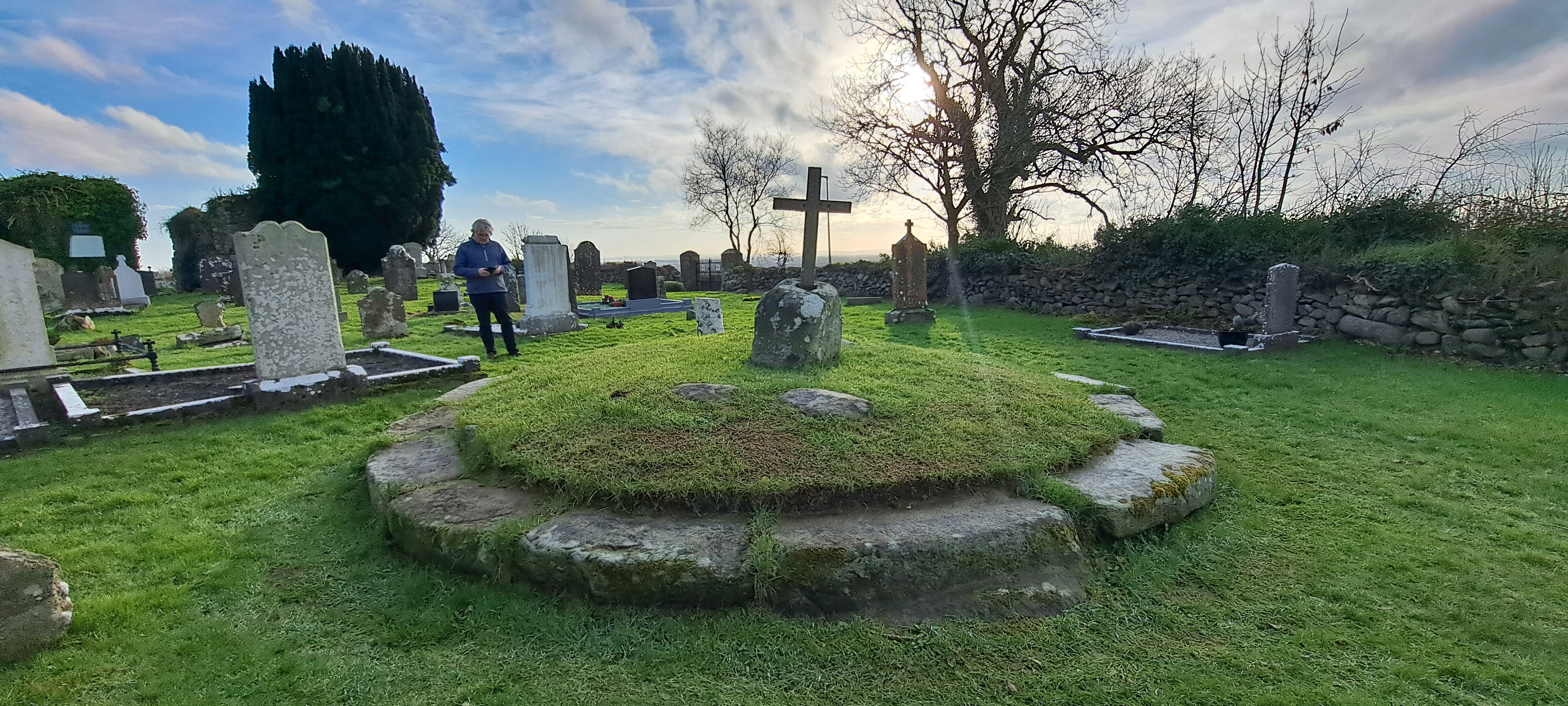
This strange, circular feature in the cemetary, known as Brigid’s Bed, has a circular raised edge with a depression in the centre and its entrance is flanked by two large stones. It once contained a large black slab in the centre, while the inside of its perimeter was also lined with stones. 2 It has been described as possibly a cairn, but it would be unusually very small, if so. More likely, it was once a small shrine where Brigid’s relics were kept.

Unrelated to Brigid, but an interesting aside nevertheless, in this cemetary lies the grave and stone slab of Edward the Bruce, the lesser known brother of Robert the Bruce, king of Scotland. He was invited over here by a group of Irish nobles who wanted ais with fighting the English. In return, they were willing to accept him as High King of Ireland. He fought a campaign in Ireland that lasted three years, culminating in the Battle of Foughart on the 14th October 1318 AD, in which he was killed and interred in the cemetary at the site where he fell.


The ancient circular site is bisected by a modern country lane, the portion of the cemetary lying beyond it farmed out of existence. Further up the lane is the Anglo-Norman motte and bailey, wild and unkempt and never archaeologically explored. The hill falls away in another stunning vista that overlooks Dundalk Bay.
At the bottom of the hill is the more modern shrine to Brigid. Its a beautiful peaceful little site, filled with tall trees and a small stream trickling through it. It is punctuated by some very ancient stones which are though to contain potent healing powers, including the Head Stone, the Knee Stone, the Waist Stone and the Back Stone. This shrine dates to the mid 1930s and is popular with tourists and pilgrims.
And in answer to the question posed in the title, after visiting Faughart it has become clear to me that this place is very much associated with the birth of a saint, not a goddess.
Brigid came to Ireland with her clan, the Tuatha de Danann. She was a daughter of the Dagda, was married to Bres, and had an adult son, Ruadán, who took part in the second Battle of Moytura. 3 There is nothing in the written record of goddess Brigid being born in Ireland (at least that I know of, but am open to, if you can direct me to it).

I want to wish you all the blessings of Imbolc as the Cailleach transfers her mantle to Brigid. As we welcome Brigid, let’s also give thanks to the Cailleach for her guardianship and winter wisdom that she has awakened in us, for her stewardship of the land and wild life in the cold dark half of the year.
The balance of power has been passed on. There may be some turbulence as the Old One settles into her long sleep (Storm Éowyn may have been a reminder of her power, and that of nature, a nod to the future if we don’t get our act together). As she does so, open yourself and let go of all your worries, let them drain away to the place beyond dreams. Now is the season of new beginnings, of manifestation of all you have dreamed during the long dark, the long cold. Now is the time for action.
I hope you have enjoyed this exploration of the Hill of Foughart with me. As you can see, it is a very liminal landscape, exisiting very much both in the past through its history and mythology, and the present… just like Brigid herself, born on the doorstep, neither of the inside or the outside but both, of church and of home, of Christianity and pagan, saint and goddess, of slave and royalty… she is all things to us all.
Thanks for being here. Much grá,


Hey… let’s talk!