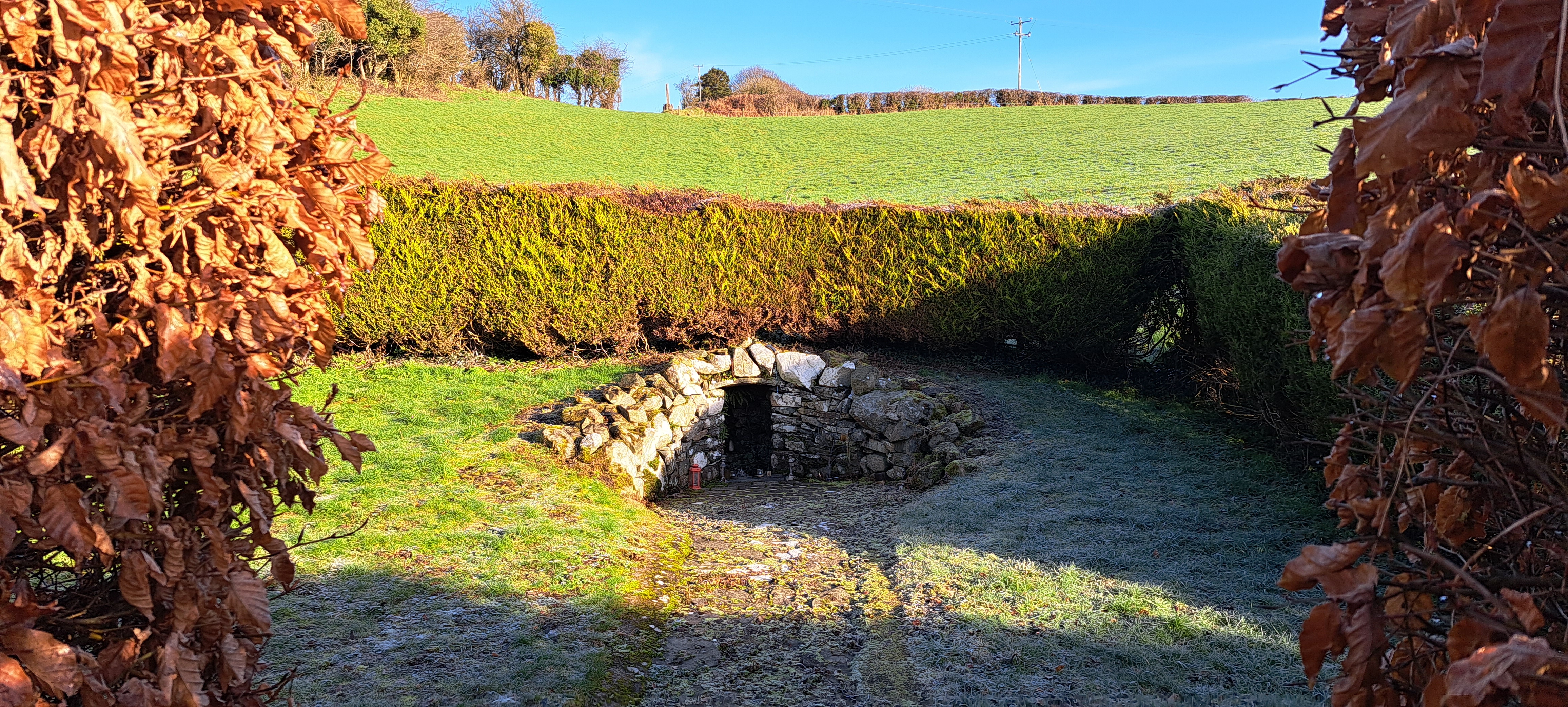
Hint: She’s not where you think
Good morning! I hope you’re out enjoying the first day of Spring. Here in Cavan, after a particularly wild and windy start to the year, the air is still, the sky shrouded from view, the light muted. There may be the promise of rain to come (let’s face it, when isn’t there in Ireland?) but for now, it’s peaceful.
I want to wish you all the blessings of Imbolc as the Cailleach transfers her mantle to Brigid. The balance of power has been passed on. There may be some turbulence as the Old One settles into her long sleep. As she does so, open yourself and let go of all your worries, let them drain away to the place beyond dreams. Now is the season of new beginnings, of manifestation of all you have dreamed during the long dark, the long cold. Now is the time for action.
I have searched for Brigid in many places over the years; the holy wells that bear her name, and the churches; Moytura, where her people fought their first battle when they arrived here and where she lost her son; the Red Hills, where her people first settled, and closer to home, Bailieborough, which is perhaps the most surprising of all.

The Stone Heads of Cavan
In 1855, an extraordinary artefact was unearthed in a small quarry on Corleck Hill near Bailieborough in Co Cavan. This unusual early Iron-Age stone head was 32cms high, made from sandstone, and had three faces, each one almost identical with a narrow mouth, bossed eyes, and a rather enigmatic expression.
Corleck Hill, from the Irish corr, meaning ‘round hill’ and leac, meaning ‘flat stone/ rock’, has a long association with the worship of the old Gods. It is also known by another name, Sliabh na trí Dána, meaning ‘the hill of three Gods’. 1

The Tuatha de Danann in Cavan
In Irish mythology, the term ‘Trí de Dána’ refers to the Three Gods of Art: Goibniu the smith, Luchtaine the carpenter, and Credne the goldsmith. Could the stone head with its three faces represent this trio of skilled craftsmen/ deities, after which the hill of its resting place was named?
Thomas J. Barron, however, cautions not to confuse them with the Gods. He believes these were human craftsmen located in an early iron age centre of industry based on grain production and processing.
According to Máire MacNeill, (The Festival of Lughnasa), “there was a custom of bringing a stone head from a nearby sanctuary and placing it on the top of the hill for the duration of the festival. 2The head looking in different directions may be . . . looking propitiously on the ripening corn-plots.”
Fintan O’Toole suggests that the Corleck head unites the old Irish religion with the new Romano-British cult. As such, the three faces could be female and represent the three ancestral mothers of strength, power and fertility. 3
But what does this have to do with Brigid? Well, as one of the Danann, and daughter of the Dagda, she was contemporary with the Three Gods of Art. When the Danann invaded Ireland and fought against the Fir Bolg, Brigid was with them.
Early on in their invasion, they settled in an area of Ireland called Magh Rein, which interestingly, is situated beside Magh Slecht (where St Patrick was said to have defeated Crom Cruach), on the borders of Co. Cavan and Co. Leitrim. From there, it’s not a long trek to Corleck, even without modern modes of transport.
Bailieborough’s Cult of Brigid
Brigid’s festival was known to have been celebrated with huge fires on Corleck Hill at Imbolc. And the Corleck head was not the only such idol to have been discovered there. According to James McKillop, the nearby Hill of Drumeague was once known as “the pulse of Ireland”, where he claims that a “stone head of Brigit was once worshipped [t]here, and the hill was the site of pagan worship on the feasts of Imbolc, Beltaine, Lughnasa, and Samain”. 4

Brigid had a triple aspect that celebrated her skills as a poet, a smith and a healer, rather than the typical maiden, mother and crone of womanhood, and thus we can see a connection with the crafts of the Trí de Dána.
It’s certainly possible that the Danann could have roamed into the region now known as Bailieborough in the search for raw materials to supply their trades. Perhaps the arrival of Brigid and the Three Gods of Art into their homeland so impressed the local people, that they honoured and remembered them in their landscape and rituals.
When Christianity claimed Cavan, the head of Brigid was hidden in a Neolithic tomb. Brigid was well loved. It’s quite likely that her followers were reluctant to give her up for the new god. So it is perhaps inevitable that her stone head was brought into the local church, where she was transformed into St Bride of Knockbride.

Unfortunately, this treasured idol has since gone missing, but there is a curious tale attached to its disappearance.
When the local parish church was rebuilt in its current position, Fr Owen O’Reilly (the parish priest between 1840 and 1844) brought the stone head from the old church in the west of the parish to the new one in the east.
He claimed that as he was passing Roosky Lake, the head ‘jumped’ out of the carriage of its own accord and fell into the water, never to be seen again.

However, there is also a story that says it lies buried beneath the new church, nestled among the foundations, perhaps in the hope that she will continue to bring her blessing upon those who worship there.
It is interesting to note that at some point between 1832 and 1900, the passage tomb, stone circle and large 64m embankment that crowned Corleck Hill, were systematically demolished and removed. 5
It could be that this was where Brigid’s head was originally hidden to keep her safe from Christian priests.
Whether this act of desecration was instigated by zealous Fr O’Reilly, who was so keen to banish the Godess’s influence, or was simply the effect of farming on the landscape, we’ll probably never know. Although I would add that I have seen cattle graze very happily around other ancient monuments in Ireland. And also, that landowners throughout history have gone out of the way not to harm ancient sites for fear of the wrath of ‘the good people’.
Although the stone head of Brigid is now lost to us, the Corleck Head can be seen at the National Museum of Archaeology in Dublin. A fairly authentic looking replica stares disconcertingly out of a glass case in the local County Cavan Museum, which also houses a fine display of other stone heads and various Sheelanagig figures, too.
My conclusion, however, is that Brigid is not located in the landscape, or any monument, holy well or stone idol. These physical objects may anchor her memory in our consciousness, but not her presence. She can only be felt in our hearts and our minds as she guides us through the fire of Imbas into our practices of healing and poetry. Keep tending that flame!
I love this poem, and how it is spoken!
There is a lot of writing about Brigid at the moment, and rightfully so. But if you’re interested in something a little different, you might enjoy reading one or all of my essays about Brigid.
As always, thank you for being here. Please let me know your thoughts in the comments below. And if I may, I’d like to ask you to ‘like’ and share my work widely, it helps my writing to reach new readers, which is what every writer wants. My writing here is free and always will be.
You can also rest assured that my writing is entirely human-made from conception, through to images, unless otherwise specified, and the final product that reaches you here. I don’t use AI in any shape or form.
Until my next post, I wish you nothing but good things. Grá Mór,

CITATIONS
- Thomas J. Barron. “Some Beehive Quernstones from Counties Cavan and Monaghan”, Clogher Record, Vol. 9, No. 1, (1976), pp. 95-107 ↩︎
- Quoted in Fintan O’Toole, A History of Ireland in 100 Objects, The Irish Times, 2011. ↩︎
- Ibid. ↩︎
- James McKillop. A Dictionary of Celtic Mythology, OUP, 2004. ↩︎
- The Corleck Head, Bailieborough ↩︎

Hey… let's talk!