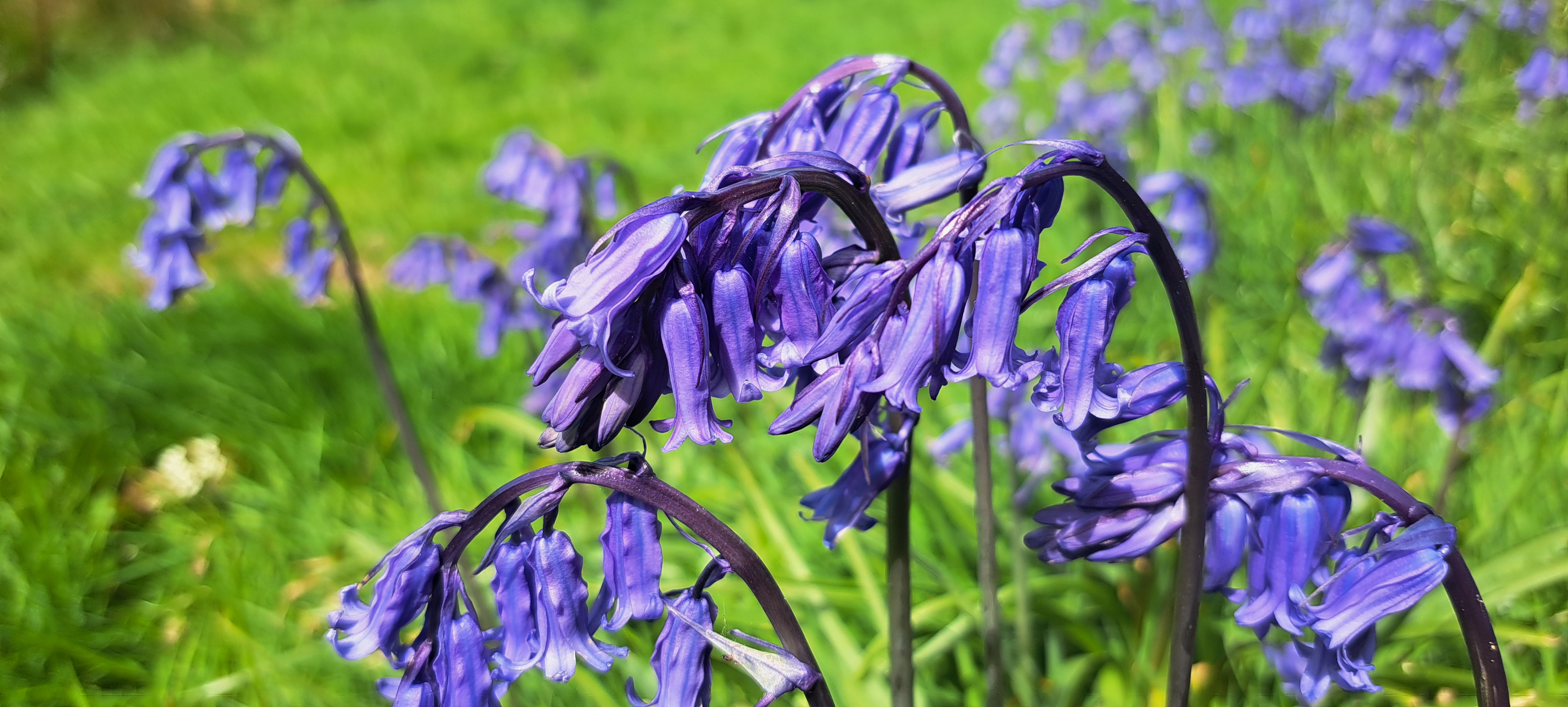
A close up of a swathe of bluebells. Irish native bluebells have all their bell shaped flowers growing from the same side of the stem, so they bow in a lovely graceful arc.

Going back to my roots in order to grow


The early days of June feel like summer is just beginning. It is only now in Ireland that the days are filled more with blue sky than cloud, and the air takes on some warmth. Light lingers in the sky way past my bedtime and almost until midnight.

I really love the long warm clear evenings of Irish summer, and the hard brightness of the stars that glitter in the clear black vastness until the orb of the sun resurfaces in the morning. It is hard to believe that in just a few weeks we will begin the slow, almost indiscernable descent into the cold and dark of winter.

Over the last two years, as I have taken to walking my local landscape, I have come to know its rythms and more-than-human inhabitants. Never a gardener, I have watched the life cycles of my local wild plant neighbours with wonder and joy. The reappearance of each one after a long winter absence feels like greeting an old friend. And every year, there are new friends to make.

This journey with the Cailleach has made me part of this multi-faceted landscape in ways I had never imagined, and is taking me in new directions that I will continue to share here with you.

But also, it fosters yearnings to reconnect with my roots. When I began writing for others back in 2012, it was to share Irish mythology, archaeology and history; these are the three roots that anchored me to Irish soil, that reached into my heart, occupied my mind, and wove patterns through my writing.

I have wandered far from those roots on this new path. The lichened, crumbling stones placed by humankind over the aeons, the stories and legends attatched to them and to the plants and animals of the wild, ourselves and our place within it, are all equal participants in this greater picture we call landscape. But although we all move across this earth leaving our marks in the mud, we are not all grounded. I believe this disconnect to be the source of much human discontent.

Some of us find our way back. I am impressed and humbled by the wave of older women in particular who reweave themselves back into the fabric of the land. Is it that we are not done mothering? Is it the transference of care from our own young to something else we instinctively feel is most in need of nurture? There is no doubt that our world is currently under attack by the actions of humankind, and that those who have the power to disrupt these destructive behaviours prefer to sit back and let it happen.

Human civilisations come and go. Dominant species give way to the ascendance of the new. Mountains rise and crumble. The sea licks the land clean. The Cailleach herself said, “When the ocean was a forest full of trees, I was then but a young girl.” 1 What goes around, comes around. Existence and time are circular. In the meantime, we do what we can. The land shows me happiness and hope.

Forestscape, even the light is green, filtered through a thick canopy of leaves, trunks narrow and broad, tall staraight and some twisted. The ground is mostly brown with thick layer of fallen autumn leaves.
Forest at Castle Lake, Bailieborough

I have written a lot about wild Irish plants lately, but I haven’t shared much of their mythology. In going back to my roots, so to speak, I will attempt to share the folklore of the plants going forward.

And right now, the fields and hedgerows of Ireland are engaged in a scrambling frenzy of green growth, high on summer plenty, and awash with the blaze of wildflowers. And one of the most impressive is this:


A swathe of tall leafy rosebay willowherb in front of a green hedge; they are just beginning to open their purple-pink blossoms, which looks so dramatic against the green background.
Rosebay willowherb grows on roadsides here, but has also begun to colonise my garden © Ali Isaac

It’s called Rosebay Willowherb. It grows up to a height of 2m, in great stretches of vibrant eye-popping purple-pink, and it’s everywhere – roadsides, embankments, railway sidings, bogland, woodland, building sites, and anywhere the ground has been recently disturbed. It brightens up all the abandoned, un-loved forgotten places, and I have fallen deeply under its spell.


Close up image of pink-purple rosebay willowherb flowers
The beautiful flowers of Rosebay Willowherb, Lus na Tine in Irish (c) Ali Isaac

In ancient times, it was the first plant to grow on the hillsides after the gorse had been burnt back, which is why it was named Lus na Tine in Irish, meaning ‘fireweed’. According to Niall Mac Coitir, historically fireweed was a rare plant. It is only in recent centuries following the upheaval of the earth in order to lay railways, fell whole swathes of forest and create industrial waste lands, that this stunning wild plant has been enabled to thrive and proliferate. 2

As such, Lus na Tine demonstrates perfectly the power of nature to adapt and reassert itself, despite what we do to it, and that gives me hope.

In this post, you can learn how to make Fireweed Tea

Medicinally, its root was powdered and thought to stop internal bleeding, whilst an infusion brewed of its leaves was used to treat asthma. However, ongoing research suggests it may contain properties that could be useful in treating cancer. 3

Despite its proliferation and beauty, however, it is a disappointment to me that I could find no trace of this plant in Ireland’s myths, even though it is a native plant. Perhaps this is due to the fact that until recent times, as Mac Coitir claims, it was indeed such an uncommon plant.

Looking over a hedge of pale pink spirea blossoms into a field carpetted thickly with creamy meadowsweet flowers are far as they eye can see, interspersed with densely leaved willow trees.
Over a hedge of spirea bridewort (not native) and guarded by native goat willow, meadowsweet grows thick as a carpet in a nearby field © Ali Isaac

In Irish mythology, Cuchulainn suffered from alternating bouts of malaise and rage. It was quite possibly drug-induced, perhaps through use of Amanita, but according to the stories, he was treated by being bathed in infusions of Meadowsweet.

The red stems and clusters of fluffy-looking tiny cream flowers of the meadowseet; in this image, many of the flowers have not yet opened, they look like tiny white balls, or beads.
Ah… my beloved Meadowseet! Apparently, Queen Elizabeth I loved it too; it was her favourite herb for strewing the floor of her bedchamber © Ali Isaac

Its Irish name is Airgead Luachra, which means ‘silver rush’, perhaps because the underside of its leaves are quite silvery in colour, but it is also known as Crios Conchulainn, which I believe is translated as ‘Cuchulainn’s Belt’. Maybe he carried the herb in a little pouch or amulet attached to his belt, in case it was required to soothe his fits and rages.

It was believed that meadowsweet could aid in falling asleep, but in folklore, there was danger in that, for it was a sleep from which one might not awake. And according to legend, Cuchulainn once fell into a sleep that lasted a whole year, during which time he appeared to leave his body and go into the Otherworld, embarking on a dangerous affair with Fand, the wife of sea-God, Manannán.

Interestingly, it is from this plant that aspirin is derived; meadowsweet contains salicylic acid, which is a disinfectant, pain-killer and anti-inflammatory.

Beginning in late June, the hedges and verges are a-froth with its downy creamy flowers, and insects adore its heady scent, a lovely gentle milky-honey-almond sweetness. On a warm day, that scent hovers in invisible clouds in the air. I feel like I wait impatiently all year for its subtle arrival.


The drooping many-blossomed heads of the bluebells which grow in great swathes beneath shady hedges and in woodlands, the wide blades of grass behind them are actually bluebell leaves.
The Irish bluebell can easily be identified as all its flowers bloom on one side of the stem, however it freely hybridises with the Spanish Bluebell, which is an invasive species here © Ali Isaac

In Irish, the Bluebell is known as Coinnle Corra. Of course, these delicate spring-blossoming wild flowers are long gone by the time mid-summer comes around, although some still linger in damp, shady spots in my local area just now. Regardless, they have their place in Irish mythology.

On her wedding night to Fionn mac Cumhall, Gráinne was said to have mixed bluebell with tormentil and secreted the mixture into the wedding guests’ wine, thus sending them all to sleep so she could elope with her beloved Diarmuid.

In The Destruction of Da Derga’s Hostel, Étain was described as having eyes of “hyacinth blue” (botanists originally identified Irish bluebells as related to the hyacinth). In another tale, The Colloquy of the Ancients, Saint Patrick is given a lift in a chariot by a young man with “cheeks as red as a bullfinch and eyes as blue as hyacinth”. 4 Clearly, the bluebell is thus associated with physical beauty.

Although it was traditionally used to stop bleeding, and also as a diuretic, I can’t find any reference to the bluebell’s sleep-inducing properties. Apparently, though, the bluebell’s sticky sap was used as a glue to bind books, and to stick feathers to the ends of arrows. Who knew?

The tiny bright yellow tormentil has four petals which grow opposite eact other, and are wonderfully heart shaped.
Tormentil blossoms; these are low growing blooms with only 4 petals. I love that they are perfectly heart shaped © Ali Isaac

Tormentil, or Néalfartach in Irish, is a little yellow flower that looks similar to a buttercup, and which commonly grows all over Ireland between May and September. It was used for pain relief and to treat digestive problems. It was also traditionally mixed with St John’s Wort to create a sleeping draught. 5

So perhaps there is some truth in the use of tormentil to send all Gráinne’s wedding guests to sleep.

Its Irish name, Néalfartach, comes from the word néal meaning ‘depression/ gloom, or sleep’, and fartach meaning ‘hurt/ injury’. In Co Cork, it was known as Lus an Chodlata, meaning ‘herb for sleep’, suggesting that it may well have been used for promoting sleep.

A few days ago, I was walking one of my usual routes musing about writing this post, and how I didn’t have a photo of tormentil to show you. Immediately, I came across a clump growing on the roadside. It is the only patch I know of in my local area. So now I have an image for you… thanks, spirit guides!

A close-up image of two primrose blooms, one wide open the other still unfurling, showing five creamy yellow petals with a deeper yellow throat, set against a green tangle of wild undergrowth.
A slightly blurry close-up of primroses, which are abundant in my local landscape © Ali Isaac

According to mythology, the warrior Nera disappeared into the Otherworld at Samhain, the beginning of winter, yet returned bearing summer flowers: wild garlic, golden fern and primroses, Sabhaircín in Irish.

This is a strange and convoluted story in which Nera receives a violent vision from the Sidhe showing the awful fate of his people if they don’t destroy the Hill of Cruachan. He warns Queen Medb and convinces her that he speaks the truth by giving her the summer flowers he brought back from Tír na nÓg.

The huge grassy flat-topped hill fort silhouetted against afternoon sunshine with a recumbent standing stone in the foreground.
Rathcrogahn, the hill fort of Queen Medb (c) Ali Isaac

Honeysuckle, known as Féithleann in Irish, is associated with the tragic love story of Baile and Aillinn. These two lovers both died unnecessarily from grief, believing the other already dead. An apple tree grew from Aillinn’s grave mound, and a yew from Baile’s. These were eventually cut down, and tablets made from them, engraved with their stories. When these tablets were brought to King Cormac’s house in Tara, they sprang together and cleaved to each other as tightly as honeysuckle around a branch and could not be parted.


Finally, the foxglove, known as Lus Mór in Irish, meaning the ‘great herb’, is used to describe the beautiful blush of the pure cheeks of Étain, Deirdre, and warrior Conall Cernach, another plant associated with physical beauty and purity in Irish legend.

The spots guide bees right up inside the bell of the flower to get to the pollen, apparently. Its fascinating to watch. It’s hard to equate such beauty and glory with danger, yet the foxglove is extremely toxic, so handle with care.

A close up view of bright cerise pink foxglove bells, the alrgest more open blossoms at the lower end of the stalk, revealing their white and purple spotted throats, the blossoms at the top still furled into buds.
The bright pink bells of the foxglove with their spotty interior. Bees crawl right up inside to collect their pollen © Ali Isaac

Stretching out new branches while roots burrow deeper.

I mentioned earlier in this post about going back to my roots in order to grow. I mean my literary roots. I initially started blogging back in 2012 about Irish mythology, because I had loved Greek myth as a child, and Arthurian legend as a young adult, but I had never come across Irish myth until I moved to Ireland. I wanted other people to learn and love it as much as I do… and believe me, Irish myth is WILD!

What I love to do is visit a place, perhaps a burial mound, an old castle, or a ring fort, and then tell the stories associated with it, particularly the female story, if I can unearth one. I’m going to do a bit more of this going forward. I hope you’ll stick around!

Grá Mór,

My signiture, 'Ali'

In the centre of this image, a narrow wooden boardwalk winds its way through a wooded valley, permitting walkers yet protecting the delicate structure of the valley floor. The valley id so green and lush, shaded by the trees with their mossy trunks.
A woodland trail through the Cavan Burren. I saw this pic on my phone and it made me think of John © Ali Isaac

Finally, I’d like to say a few words in honour of John Willmott, also known as the Woodland Bard, who passed away recently. I know that some people who subscribe to H A G came here from John’s Substack, Nature Folklore, and you may not yet have heard of his passing, or were wondering why he hasn’t sent out any newsletters lately.

Man in white tee shirt with brimmed hat on his head holding a walking stick in his left hand, and an open book in his left hand. Behind him there is an expanse of water with trees growing on the opposite bank right into the water's edge
John

Although I only met John once, I’d known him for many years via our online presences. We were interested in, and always supported each other’s work. He had so much knowledge stored away in his mind, and was always so generous in sharing it with others. I learned a lot from him, and will miss his comments and his wise insights popping up on my newsletters.

John was laid to rest in a beautiful wild woodland grave on a sunny day in the dappled shade beneath tall, swaying trees where birds were singing, and butterflies were fluttering. It was the perfect spot for him. Rest well, John.

Somehow, rather than resting, I think he is more likely to be having poetry duels with the Sidhe in the Otherworld!

His Substack, Nature Folklore, is still online, and you can still subscribe.


We give flowers to tell someone we love them. Well, there are plenty of wild flowers here today, so why not spread the love and share this post? And don’t forget to like and subscribe! Le grá,

My signiture, 'Ali'

CITATIONS
1

An Cailleach Bhearra, Screen Ireland. This short film is hauntingly beautiful and quite entrancing, well worth a watch.

2

Niall Mac Coitir’s Ireland’s Wild Plants – Myths, Legends, and Folklore, The Collins Press, 2018.

3

Call me cynical if you like, but I just don’t think big Pharma actually want to find cures to our health conditions in wild plants; they can’t control the spread of so-called ‘weeds’, and people treating their ailments for free is detrimental to their profit margins, so the results of their research (the re-learning of lost/ suppressed knowledge) is (again) supressed.

4

See no. 2 above.

5

Ibid.

43 responses to “Flower Power in Irish Mythology”

  1. Joseph Proskauer avatar
    Joseph Proskauer

    Where can we find your earlier mythology writing?

    1. Ali Isaac avatar
      Ali Isaac

      Hi Joseph, I closed down that blog about 5 years or so ago. Was it something in particular you were looking for? I’ll help if I can.

  2. Jenni Bardi avatar
    Jenni Bardi

    Sorry to hear John Wilmott died, he wrote some really interesting pieces and I can see how you connected with him.
    I love this wildflower post ❤️

    1. Ali Isaac avatar
      Ali Isaac

      Thanks, lovely! Funeral was down your way, I did think of calling in on you at work and taking you for a coffee, but I had to get home for Carys. 😘

  3. Ali Isaac avatar
    Ali Isaac

    Hi Deirdre, glad you enjoyed it, and yes, I did think of you when I wrote it! Deirdre was a pretty strong willed and determined woman, I have a lot of admiration for her. I wrote a feminist retelling of her story from her own pov, perhaps I will share it here, if anyone is interested in that kind of thing. Hope you are well, and thanks for reading! 💕

  4. Carmine Hazelwood avatar
    Carmine Hazelwood

    What lovely flowers and especially it is wonderful to hear of their place in Irish culture and folklore. And how interesting to compare your native wildflowers with their North America cousins. Fireweed (same species) is native here, also. What we call meadowsweet here is Spirea alba, also in the Rosacae family — but we do have a similiar Filipendula species here called Queen of the Prairie, which is pink. Bluebells native to Eastern US are unrelated to hyacinth, being in the borage family…but we do have wild hyacinth, which is in the Lily family and is more blue than your gorgeous bluebells that look almost purple. When I think of hyacinth-colored eyes, I think of Elizabeth Taylor, remarked upon for her “violet” eyes and a very beautiful woman indeed.

    1. Ali Isaac avatar
      Ali Isaac

      She absolutely was! Thank you so much for sharing your native wild plants here, that is exactly what I hope for! I wish Substack enabled the option to add photos to comments, that would be wonderful, so we could all share images here, but unfortunately it is not something available yet. I would love to see the differences and similarities. Thank you, Carmine 💕

  5. Finola Finlay avatar
    Finola Finlay

    Hi Ali – Lovely post. Foxglove is also known as Lus na mBan Sí and Méirín Púca – much better names than Lus Mór!

    1. Ali Isaac avatar
      Ali Isaac

      Hi Finola, you’re right, they are much better names, thank you, I will edit the post to include them. Incidentally, I was researching native wildflower meadows the other day and came across some posts of yours all about that, now I understand about all your wildflower insta posts… I did not realise you had rewilded a meadow! It was very inspiring to me as I am going through this process myself with my own small patch of land. 💕

  6. deirdre máire avatar
    deirdre máire

    Another brilliant post. (Loved the part with the foxgloves and the description of the beautiful Deirdre) 😂 Thank you – loved this post. Will be looking out for all of these wonderful plants and flowers with fresh eyes 💚💚💚☘️☘️☘️

  7. Ingrid Finch avatar
    Ingrid Finch

    What a treat to read about all my favourite things in one go! Herbalism, plants, myths and Ireland. And the video blew me away, as did the pictures of the bluebells. I suddenly got a wonderful memory of walking in a bluebell woods with my Irish granny and discussing their divine colour.
    Thank you for your beautiful stories of living in awareness and connecting to the Earth.

    1. Ali Isaac avatar
      Ali Isaac

      Thank you, Ingrid! It’s wonderful to meet like-minded people here, isn’t it? What a beautiful memory to have of your Granny… walking in a bluebell wood is truly magical, and cameras never seem to quite capture their vivid colour or their magic. Thank you so much for reading, and commenting. 💕

  8. Kelly Hargie avatar
    Kelly Hargie

    Ali, this is so so so beautiful! I loved reading it and am excited on the direction you are headed with future sharing. All sounds wonderful. x

    1. Ali Isaac avatar
      Ali Isaac

      Thank you, Kelly! It’s lovely to hear that. 💕

  9. Robin Heart Shepperd avatar
    Robin Heart Shepperd

    Over the years, I adored your posts on Irish mythology and they brought me to the privilege of hiring you to be a guide for my Irish tour and meeting you. I am delighted that you are now discussing the flora of Ireland and including those myths. Your posts are always appreciated and enjoyed. I am proud to be a member of H A G.

    1. Ali Isaac avatar
      Ali Isaac

      Robin, thank you so much! I enjoyed meeting you that first time and showing you around my favourite places, and every time since, and I hope we will get to explore Ireland together again in the not too distant future! We have had a lot of fun together! 💕

  10. Noelle Granger avatar
    Noelle Granger

    I love your posts, Ali. They take me back to the earth. I learned a bit of herbalism when I wrote my last historical novel and remain interested in how plants were used as medicine – and still all.

    1. Ali Isaac avatar
      Ali Isaac

      Thank you. Noelle… it’s amazing what we learn in the pursuit of telling a story… or writing a novel! It’s so easy for us to get carried away by the demands of modern living, which removes us from the land and from nature. I am very concerned about climate change and the lack of action by our leaders. Instead of becoming depressed by that, I’ve resolved to do what I can, and that means educating myself about my local landscape, and doing what I can for nature on this little patch of land that comes with my house. I feel like I have been called back to the earth, back to wildness. 💕

      1. Noelle Granger avatar
        Noelle Granger

        You’re doing a great job of it!

      2. Ali Isaac avatar
        Ali Isaac

        Thank you 😍

  11. Terri Seddon avatar
    Terri Seddon

    Thanks for these beautiful flower stories. I really like the way you weave myths, herbalism and images together into a story about living and growing.

    1. Ali Isaac avatar
      Ali Isaac

      Hi Terri, thank you so much! That’s great to hear. My phone is full of images of wild plants, and my head is full of stories and legends… the herbalism is a new journey for me, but somehow it is all beginning to entwine and thread through my own life experiences. If I don’t put it here, I’d probably explode! 😂

      1. Terri Seddon avatar
        Terri Seddon

        I can relate to that! Have you read Robin Wall Kimmerer? She weave science, Indogenous knowledge and stories together too

      2. Ali Isaac avatar
        Ali Isaac

        Yes, I read her last summer, her book had quite a profound effect on me. It was assigned reading for one of my modules at college, but it was only last year, when I reread it, probably because I had more time to engage with it, that it took on new meaning for me. She certainly made look at the world with new eyes! 💕

  12. Lisa avatar
    Lisa

    Being Canadian with Irish ancestry, I really appreciate your posts. I haven’t been to Ireland, but the more I read and see (That video is gorgeous!), the more I want to see it.
    Thank you for educating me:)

    1. Ali Isaac avatar
      Ali Isaac

      You have Ireland in your heart and veins! That video is gorgeous and shows the land’s grandness… if that’s a word (I’m having trouble finding the right words today 😆). I’m at the other end of the spectrum, showing off its humbless, which turns out to be just as awe inspiring, judging by the lovely responses I see here. Grá mór to you! 💕

  13. Mari Kennedy avatar
    Mari Kennedy

    Thank you as always Ali for the images the words the love and wonder you spread. 🌹🌻🌞🌦️🌻

    1. Ali Isaac avatar
      Ali Isaac

      Thank you so much, Mari! I’ve heard it said that as we age we enter a kind of second childhood, and I sometimes feel like a child wide-eyed with wonder when I encounter a new wild plant being! 😂

  14. Jane Pike avatar
    Jane Pike

    Ali, this is so gorgeous- I was on an Irish wildflower adventure with you and I loved every moment! I need to read it a few more times to even touch the edges of everything here. Thank you!

    And so sorry for the loss of John. Sending much love your way xx

    1. Ali Isaac avatar
      Ali Isaac

      Thank you so much, Jane! John’s words and wisdom touched a lot of hearts, I think.

      Glad you enjoyed the Irish flower power. I’d love to take people on a tour of the hedges and verges and share these plant neighbours with them. I hope my wanderings inspire people to wander their own localities to see what plants are hiding there in plain sight! 💕

  15. Sandra Cooke avatar
    Sandra Cooke

    I love “going back to your roots in order to grow”!! The mightiest trees have the deepest roots and also where does a seed go in order to germinate?… it also roots deeply. This thought came to me a few days ago about how important it is to be grounded into the land! Thank you Ali! I love that we’re on the same page ish! Grá mór.

    1. Ali Isaac avatar
      Ali Isaac

      Hi Sandra, I totally agree with you, there’s nothing nicer than taking off your shoes and walking barefoot, connecting with the land physically, skin to skin… being with the earth like that draws you in in other ways too, mentally, emotionally, sympathetically, consciously and unconsciously. Over the centuries humankind have put so many barriers between ourselves and the land, from socks and shoes, to carpets and concrete, to tv and computer tech. I’m slowly dismantling those barriers, and it’s so… joy-inducing… do we even have a word for creating joy? I want a word like ’empowering ‘, but can’t think of one!

      1. Sandra Cooke avatar
        Sandra Cooke

        Yes totally! Embodying?? I’m not sure of that one either. I know what you mean. It’s the parts of us that are completely one with nature and the land and when they connect they sing ♥️

      2. Ali Isaac avatar
        Ali Isaac

        Oooohhh… I like that idea, ‘they sing’, yes! 💕

  16. Whitney McKnight avatar
    Whitney McKnight

    I discovered you in, I think, 2018. It was a post about the Tuatha De Dannan and it was all I could find online at all about the Shining Ones. Thank you for sharing your discoveries! And condolences to you and other for the loss of John. xW

    1. Ali Isaac avatar
      Ali Isaac

      Hi Whitney, I know the post you mean, I think it also featured a photo of my red-headed blue eyed son as an example of what the Danann may have looked like, according to the descriptions in the legends. Thanks for sticking with me all these years! 💕

      1. Whitney McKnight avatar
        Whitney McKnight

        For a while you seemed to disappear. I was so happy when I found you again on Substack!

      2. Ali Isaac avatar
        Ali Isaac

        I did indeed ‘seem’ to disappear, you’re right, but what happened was, WordPress became too expensive for me to create visually the kind of website I wanted, I was unemployed and at home raising my family, I couldn’t justify the expense. So I transferred all my work over to Wix, but in doing that, lost all my online presence. When people googled anything to do with Irish myth, I would always show up on the first page. When I moved over to Wix, I lost that, it was like starting from scratch with a brand new website and no followers, I even lost all the comments people had written, WordPress kept those. I was gutted, but I slogged really hard to try and make the best of it. But I was very disillusioned, and then I went back to college and had no time to write. And then I got hit by perimenopause. Ugh. Everything was a mess. I decided to give it one more try on Substack, and here we are! ❤️ Substack! And have ‘met’ some lovely people here! 💕 In fact, writing on Substack reminds me very much of the early days of WordPress, there is a really great community here.

      3. Whitney McKnight avatar
        Whitney McKnight

        It is an excellent tool for connecting without the agro. You got a lot done in your absence from the Internet. x

      4. Ali Isaac avatar
        Ali Isaac

        I always think I’m lazy compared to other people, until I look back and realise my achievements. We don’t acknowledge and celebrate them enough, do we?

      5. Whitney McKnight avatar
        Whitney McKnight

        No, we don’t. You know I am cataloging my own work now and my gosh, I have been prolific, and not with fluff, either. It’s helpful to be reminded because I lately have been wondering why I don’t feel compelled toward anything currently. I reckon, just wait. It will show up and take me towards it whether I want to or not if my past work is any indication…

      6. Ali Isaac avatar
        Ali Isaac

        I absolutely agree, be patient, it’s distilling within you. We have a saying in Ireland, ‘what’s for you wont pass by you’… it’s coming, but not until you’re ready, and you don’t get to decide when you’re ready, the universe does!😂 Sounds mad, but that’s been my experience, too. 💕

      7. Whitney McKnight avatar
        Whitney McKnight

        I triple “like” this. xx

Hey… let's talk!

Discover more from Ali Isaac

Subscribe now to keep reading and get access to the full archive.

Continue reading