Navigating literary and literal pre-apocalypse
When I last wrote to you a couple of weeks ago, I thought I had come to terms with my love-hate relationship with SubStack. Incredibly, in the short space of time since then, SS has managed to make things even worse, because they have now introduced an AI text detector supplied by Pangram.
(A note for those of you reading me here on WordPress; SS high standards have been steadily dropping over the years to the point I no longer feel comfortable having an online presence there. Hence my recent move to WordPress. See my previous post for more details. Happy to be here!)
AI Text Detectors : A Literary Pre-Apocalypse?
SS want you as readers and us as writers to think this is a good move, but in reality, all it will do is sow division, suspicion and confusion.
Readers will now assume SS has a terrible AI slop problem. Perhaps it does, but this new feature is not going to help you sort the wheat from the chaff. Readers will now waste their valuable time checking every post and Note for AI written content.
And guess what? These detectors are notoriously inaccurate. They often fail to detect AI written content, but will proclaim classic texts written long before AI was invented as AI written. Why? Because they were trained on these texts and recognize them. In other words, they can’t definitively detect what is original and what isn’t. Why? Because they are regenerative. They can only vomit out what they have digested. They can’t think. They can’t create. So at the end of running a post through the detector, you will be none the wiser. The seed of doubt has been sown simply by the presence of the feature.


What does it mean for writers? It means trust between writers and their audiences has been erased. If a writer uses only an AI spellcheck, it could be detected as AI-written. If the whole piece is totally AI-written, it may or may not be detected. If the writer has totally created a post from scratch without any AI assistance whatsoever, it could still be tagged as AI-written.
What can readers do? Don’t use the AI detector. Use your own intelligence and critical thinking to decide. If you have been subscribed to someone a long time and have read all their posts, it will be pretty obvious to you. If a writer is new to you, but their work has resonated, it is for a reason. If anything seems a bit ‘off’ to you, trust your judgement; it probably is.
And what about writers? There is a button that turns off the ability for a reader to check for AI, but it is buried deep in the writing process, and SS has not made it easy or obvious for writers to access. Full disclosure: I will be making use of this button. Author reputations and careers have already been ruined by AI detectors.
A case in point. On Friday, I read in The Bookseller that ‘a genius novel’ which sold in a ‘seven-figure deal had been pulled over suspected AI use’. Note the word ‘suspected’; it appears nothing has been proven. An editor had raised their suspicions, the agency sat down with the author who denied it, so the deal went ahead. AI recognition software was not used. It was a $2 million deal. However, later, the author was less clear about their use of AI. Rather than hiding this and chasing the money, both the agency and the publisher decided not to go ahead with the deal.
A deal like that is life-changing for an author. If they did use AI, the agent and publisher made the right decision. Kudos to them. But if the writer didn’t use AI to write their book, their career and future prospects have now been destroyed.
What’s interesting to me about this new move by SS is not the introduction of the AI detector itself, but what it confirms about their business model. Just as they don’t mind making money from hosting misogynist and nazi newsletters, they also clearly don’t mind making money from AI written slop. Providing the detector on their platform instead shifts the onus on you, the reader, not themselves or the AI-worshipping writer.
AI has already taken a wrecking ball to the creative arts. If literal literary theft hasn’t convinced you of tech bro toxicity, in a very nazi-inspired move, they are now buying up old and rare print books to feed into their AI machines, and then destroying them. Meanwhile, the issue has moved beyond livelihoods, inspiration and artistic authority. AI can only recycle what it has been trained on. Soon, it will be training itself on its own AI-created slop, because what else will be left? The slop is only going to get sloppier.
As you know from my last post, I am trying hard to extricate myself from toxic tech. Remaining on Substack feels like fanning the flames while fighting the fire.
Fighting Fires
I’m watching much of Europe burn as Ireland shrugs back on its misty grey mantle of cool, damp weather, and it’s heartbreaking. During the heatwave, the clay soil of my hilltop home baked hard, and most of the veggies I planted failed to grow. But the lowlands around me are mostly bog, and so with their roots digging deep in the dark, dank earth, the native flora continued to thrive. This surprised me, because it is not the story elsewhere. Swathes of Ireland are suffering a hosepipe ban, and wildfires have also licked over drier landscapes recently in Tipperary, Kerry and Wicklow.
If you could smell the future, it would be the acrid scent of burning landscapes.
— John Gibbons, The Journal 1
And let’s be honest. The climate crisis, toxic tech, the forever wars, the powerful oil and gas conglomerations, genocide, the Epstein files, the rise of misogyny, the AI being forced on us whether we like it or not. All these things are ravenous flames dividing and consuming us, and they are all connected.
Inertia is not an option. We must all become fire-fighters.
Toxic Tech Untangled So Far
This is the first fire I’m tackling. Some of you expressed an interest in my efforts to remove myself from toxic tech. It is my firm belief that AI, social media, and tech in general doesn’t have to be the way our wealthy US toxic tech bros have made it. The journey is far from over, but here is where I’m currently at. I experimented with a few different platforms before choosing these ones.
Email — swapped Gmail for Proton. I took out a paid subscription. I don’t mind paying for good tech that I use a lot, but I tried the free version first and liked it. It’s private, and you get free use of a VPN. Also, its European. Click here for other European alternatives.
Browser — swapped Google Chrome for Waterfox. It’s private, open source, and based in the UK. It comes with a selection of search engines you can alternate between. Click here for other European alternatives.
Search engine — swapped Google for Startpage and made it my default search engine for my phone and laptop. It’s free, private and based in the Netherlands. You can also browse anonymously if you want to. Click here for other European alternatives.
Word Processing — swapped Word for LibreOffice. This one was important to me because I needed a good tool for my writing. LibreOffice is open source and not-for-profit, and you can download it for free. It didn’t take long to get used to, it’s not much different from Word in how it works, and I like it. I will be making a donation, because its worth it. Click here for other European Microsoft Office alternatives.
Social Media — I would dearly love to leave Instagram, but still working on this one. I’ve registered with W Social, the new Euro platform which seems to be getting popular, but still waiting for my invite. I’ve tried Upscrolled (got a slew of DMs from potential sugardaddies before I even made a single post, so deleted!), and Monett, Pixfed, BeReal and Diaspora, but as I’m not a SM fan, I can’t honestly say any of them floated my boat. I’ll wait for W. Click here for other European social media alternatives.
Next Priority — Next up is the search for a new operating system to replace Microsoft Windows. I need to have an operating system so I can actually use my beloved laptop, but I’m a bit afraid of this challenge, it seems like a biggie to me. Zorin OS would be my pick; it’s Irish, open source, and based on Linux, apparently. They claim it will make your computer ‘faster, more powerful, secure, and privacy-respecting. All while staying familiar and simple to use’… sounds good, similar in appearance to Windows is an advantage as I’m not keen on the idea of relearning a whole new system if I don’t have to. Fingers crossed.
On the Backburner — Replacements for Google Maps, SS, Google Pay (may go back to using physical cards, seems so last century haha!), and eventually replacing my phone with a Fairphone or Nothing Phone.
Quenching Fires with Fireweed
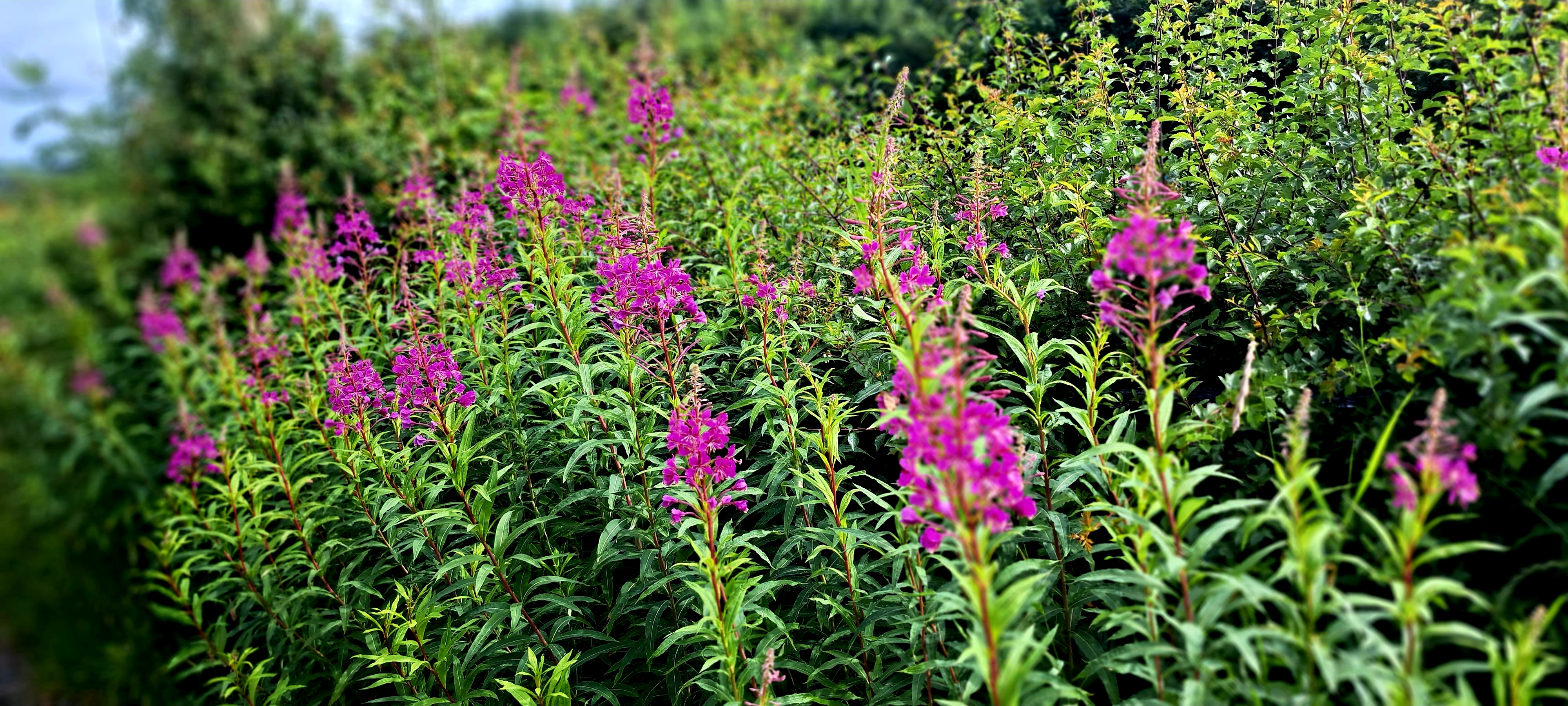
It’s fireweed season in Ireland. These gorgeous graceful bright pink blooms are in full sway across the landscape, beautifying unloved and neglected areas like rough banks and ditches, road verges, bogland, disused railway sidings, waste ground and anywhere that the land has been in upheaval. They are said to be one of the first plants to appear after the ravages of wildfire, so to see it emerging now feels somehow reassuring. From the ashes and smouldering soil, new life will emerge. Its common name is Rosebay Willowherb. In Irish, it is known as Lus na Tine.

This wild plant has so many uses besides cheering us with its blushing colour and elegant movement. Its stems can be eaten when they are young, or harvested for its fibres to make cordage. Its leaves, when tender, can be eaten lightly cooked like spinach. I like to make tea from the leaves, which involves a fermentation/ oxidation process, and was taught to me by my friend, Jenni. See how in the short film below.
How to make Fireweed Tea


Rosebay Willowherb is a very generous wild ally with many health benefits for our bodies. Traditionally, it has been used to treat urogenital diseases, stomach and liver disorders, and skin problems. Research has shown that it contains anti-androgenic, antiproliferative, cytotoxic, antioxidant, anti-inflammatory, immunomodulatory, and antimicrobial properties. It has been found to be rich in polyphenols which support beneficial gut bacteria so it’s no wonder it was commonly used to treat stomach complaints. 2
The appearance of fireweed right now is so important because its abundance and vibrancy is a symbol of hope. Its rugged determination springing from scorched earth as a pioneer plant paving the way for regeneration after wildfires serves as inspiration for us to keep going. The fact that it does all this while providing of itself as healing medicine is astonishing and humbling in equal measure. 3
But here is why this plant matters to me right now.
Fireweed is also believed to have a calming effect on our nervous system. Regular consumption can help reduce stress and promotes the production of our feel-good hormone, serotonin. Its mild sedative action can help improve the quality of sleep, and help balance our emotional state and general well-being. 4
Aren’t we so in need of that as the landscape burns, as the fires of war explode, as politics inflame division to flash point, as the earth shakes and cities are flattened. But we are resilient, and so are our plant neighbours.
Look out your window. Rosebay willowherb is probably waving at you from a ditch or a crack in a pavement somewhere, just at the point in time when we need it most. The planet is generous to a fault, to its own destruction. Go out and find your local proliferation of fireweed. You deserve the pleasure of wandering in nature, gathering plant material to slow-craft a natural, healthful self-care product. Enjoy!
Gather responsibly. You can remove the lower leaves without harming the plant. Leave most of the flowers for pollinators and for the plant to self-seed.
Do your own research. Only use a plant if you can 100% identify it. Fireweed is harmless for most people, but avoid or get medical advice prior first if you are pregnant, have any allergies or health conditions.
1 Gibbons is an environmental journalist and author. Read his article (linked) for The Journal; it is an eye-opening insight into Ireland’s governmental position on the climate crisis.
2 You can find out more about research into the medical uses and properties of fireweed on Researchgate.
3 Fireweed tea has a long and fascinating history which you can read on the Tea of the North website.
4 The many benefits of fireweed tea are explained in detail here.


Hey… let's talk!