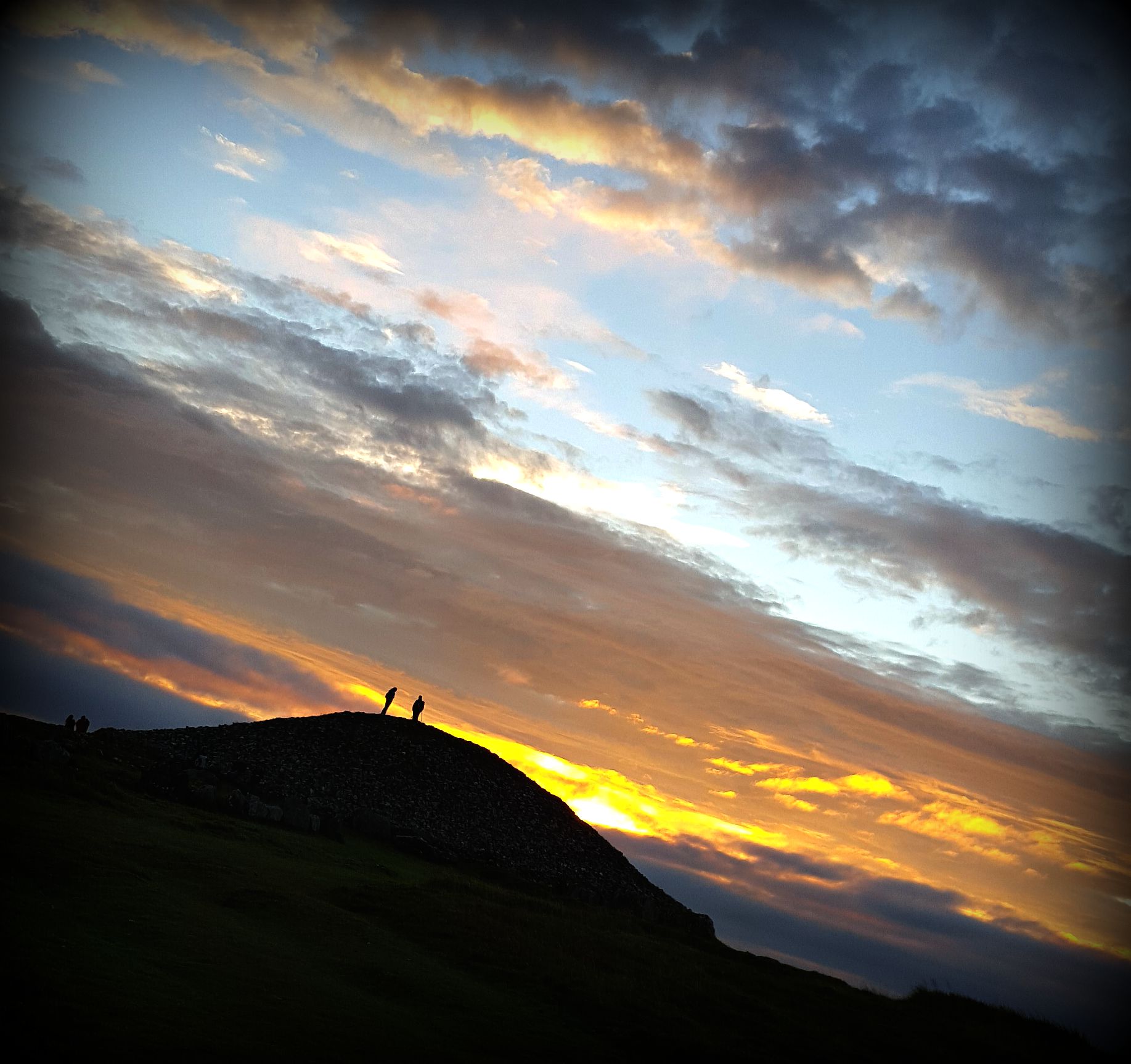
The Cailleach is coming…
Vera [Bheara], the celebrated goddess, sorceress, or hag, of ancient days. The legend current in the neighbourhood, is to the effect that she came onetime from the North to perform a magical feat in the neighbourhood by which she was to obtain great power if she succeeded. She took an apron full of stones, and dropped a cairn on Carnbane; from this she jumped to the summit of Slieve-na-cally, or Hag’s Hill, a mile distant, and dropped a second there; from thence she made a jump, and dropped a cairn on another hill, about a mile distant. If she could make another leap, and drop the fourth cairn, it appears the magical feat would have been accomplished, but she slipped, fell, broke her neck, and was buried in the neighbourhood. 1
Who was the Cailleach?
The Loughcrew cairns are described as being created by a giant hag or witch who dropped stones from her apron as she leapt from hilltop to hilltop in an attempt to wield some kind of spell or great magic.
This folklore explains the creation of a regional geographical feature, and is one of many such local legends found across Ireland, indicating that the Cailleach is most likely an entity popularly associated with structuring the landscape. The poem in the video suggests the Cailleach is also associated with winter, and death.
The Cailleach is reputed to be so ancient even she does not know her age. In some stories, she must return once in every hundred years to bathe in a particular lake. Immersed in the cold waters, her aching aged body is soothed and her youth is renewed.
The restorative power of water here has echoes of Dian Cecht’s magical lake of healing. However, the Cailleach is not of the race of the Tuatha de Danann. She is not mentioned in any of the four cycles of Irish myths. Medieval Irish writing seems devoid of her presence, and academics are therefore of the opinion that she is a fiction of modern times.
The Cailleach in Folklore
Her lore has instead been preserved via the oral tradition and thus passed into modern folklore. However, how far back in time these oral stories originate cannot be determined. Geróid Ó Crualaoich writes:
the discipline of folklore … [is a] study [of] the process whereby stories are continuously transformed, in performance and transmission, in ways that reflect the changing historical and socio-political circumstances of their narration, and yet continue to maintain and to articulate … a considerable degree of insight into the deeper realities of human life and culture. 2
This means that despite their continuing appeal and resonance for the listener, narrators are constantly adapting the stories to suit their own period of telling, or to flatter their patrons, so that it is no longer possible to pinpoint a feature of the tale or language that might indicate a particular moment of origin.
Regardless, in Ireland and Scotland the legends of the Cailleach have endured. She is interpreted not just as the creator of landscape and controller of winter, but also as as the figuring of the wise-woman and healer, and the witch. She has arcane knowledge that she is capable of using for good and ill.
According to Ó Crualaich, the Otherworldly female figure of the Cailleach has “actively informed cultural developments – artistic, political and ritual – in the course of the early modern era”. 3

A Change of Attitude
The first flutters of anxiety arrive with the meadowsweet, the foxglove, and the rosebay willowherb. My favourite wild friends. I have awaited them all year. They signal high summer, and yet my joy is coupled with a faint sense of regret, for they are last to bloom.
No ripple of colour will spread through the hedgerows and fields to replace their blaze of glory once they have faded back into the earth. Even the grass stops growing. Trees weep their leaves and raise bony branches to the heavens. Lowering skies, rising winds, stifling fog, lashing rain and hail. More darkness than light. And even the light is grey, water-washed, and weak.
Winter is coming.
That used to be me.
Seasonal Affective Disorder (SAD) is real. It is thought to be depression brought on by a lack of sunlight; apparently, sunlight affects the hypothalamus which regulates mood, appetite, and sleep. Although SAD is still not fully understood, it seems the production of hormones melatonin and serotonin are inhibited in some people in the winter, their body’s natural circadian rhythms disrupted.
Back in the day, I didn’t know about SAD, but my body felt it, and my mind was tormented by it. Now, it is a condition recognised by medical professions, and there are treatments available. Back then, I thought I was going mad, and kept it to myself. And because I’ve always been a bit of a loner, the distance I drew between myself and others acted like a barrier, a cloak, a kind of Faeth Fiadha that hid many secrets. People who suffer from depression are often very good at hiding it from others.
It was only after living in Ireland for some years that I found a cure. For me, the result felt dramatic, although it took place over several years. Be open-minded. Be aware that not all cures involve drugs or doctors. Not all medicines are taken by mouth or administered by needles.
An often quoted proverb claims that a change is as good as a rest, and whilst adequate rest is crucial to one’s physical and mental wellbeing, there is some truth in it. My cure involved a change. I changed my way of thinking about winter. I changed my attitude.
A Google search tells me attitude is a settled way of thinking or feeling about something, a behaviour caused by one’s way of thinking or feeling about something, a negative or hostile state of mind, a bodily state of readiness, bodily position or posture.
In psychology, an attitude refers to a set of emotions, beliefs, and behaviours toward a particular object, person, thing, or event. Attitudes are often the result of experience or upbringing. They can have a powerful influence over behaviour and affect how people act in various situations. While attitudes are enduring, they can also change. 4
In other words, the attitude we adopt can have physiological effects, impacting not just our mental and emotional state, but our physical state as well.
My experience of SAD generally took hold in November when the nights drew in to about 4 or 5 pm in the afternoon. But, as I mentioned earlier in this post, it would be pre-empted by fleeting feelings of sadness when the last of the summer wildflowers began to fade. I saw the onset of winter as a negative thing. The long lead up to Christmas was a pleasant, often stressful distraction, but January hit hard.
The 4 Irish Fire Festivals
When I moved to Ireland, though, I immersed myself in the land’s past, its history and mythology. I learned about the solstices, and the equinoxes, and how these solar events were marked. For me, this knowledge was transformative.
In Ireland, people would traditionally celebrate four fire festivals which kicked off each season: Imbolc, which marked the beginning of Spring; Bealtaine, associated with Summer; Lughnasa, which heralded the autumn, and also celebrated the harvest, and Samhain, which celebrated the arrival of Winter, but also coincided with what we now know as Halloween.
In between, there are the two equinoxes in March and September, when day and night are of equal length, and the two solstices in December [shortest day in the northern hemisphere] and June [longest day in the northern hemisphere].
These fire festivals were social gatherings that included the lighting of great bonfires, music, dancing, storytelling, sports and games, feasting and carousing. There were probably religious ceremonies, marriage promises and political alliances made, buying and selling, and all manner of transactions that constitute the full range of human interaction and engagement. These events must have been hugely anticipated by the communities that celebrated them.
Winter had always seemed such a long season to me. Of course, scientifically, it wasn’t, but I felt it as such. But when I divided it according to this new-to-me Celtic Calendar, I found there were approximately only 7 weeks between Samhain and Winter Solstice, then only six weeks or so until Imbolc, meaning we had already arrived at Spring. It is then only about 7 weeks until the Spring Equinox, after which we are well on the way towards the arrival of summer.
Dividing the dark cold season into these smaller component parts made all the difference to me. I could manage these small chunks of winter. And I noticed in January that the days were already beginning to lengthen.
I began to feed the birds in my garden, and their energy and antics brought me great joy. Drawing cold air into my lungs when I went out walking felt energising. The lacing of bare winter branches against a cloud laden sky reminded me of the tangle of blood vessels within my body, pumping warm blood to all my organs and extremities. The frost that transformed the colourful world I inhabited into monochrome and glitter was a beauty that cut me, sharp as a knife, whereas before, I had only seen it as a danger and inconvenience.
During the pandemic restrictions of Winter 2021, my acceptance of the cold finally morphed into a strong desire to immerse myself in cold water. I just needed to awaken my senses, to reconnect with my body, which, as I progressed through perimenopause, felt increasingly alien and dormant to me.
Ritual and Ceremony
Although I am not a great believer in the necessity of ritual, marking each festival with fire, for me, certainly helped. Each ‘ceremony’ ended one of those small chunks of winter and heralded the next. In a way, it was a kind of laying to rest and at the same time looking forward. Fire is cleansing, smoke is purifying, and my ‘ceremonies’ are as simple as intentionally lighting a candle or an incense stick. Grand gestures are not always necessary. Although I do love getting a fire going in the firepit on clear nights.
I admit, the summer nights where light continues to shimmer through the sky until 11pm, and the fall in temperature requires only a light wrap or fleece to keep it at bay, that would be my season of choice.
But acknowledging the wisdom of the old ways, and learning from them has helped me maintain a more even state of being through the winter. And whilst I still feel some regret when the last of the wildflowers signal the close of summer, I no longer experience the weight of dread as I used to.
Winter is not death but renewal. It is the earth’s fallow period, its time of rest and recuperation while it prepares to dazzle with its sassy springtime attitude.
If you think it’s too simple to work for you, just try it. Plot the festival days on your calendar, mark them, give thanks, welcome in the new, and see how quickly the time flies. You already know each day is getting longer, even when you can’t yet see it. It is inevitable. It is science.
The peoples of the past understood this cycle, yet in our sophistication we seem to have forgotten it. How far removed we have become from nature. And how detrimental that can be to our state of physical and mental health.

The Cailleach and Renewal
You may be wondering what this has to do with the Cailleach. As I said in my post, Excursions into Darkness, in the darkness new light is born, new ideas, new life. I can see the truth in that.
But also, as winter embodies the dark, entering one’s hag years is like a foray into the winter of one’s life. I do not see this as death, although that will inevitably come as it does to all, but as moving from mother to crone.
It is a transition, a time to explore a creativity that does not hinge on reproduction, to learn old ways as if they are new, to open up to Imbas, that shining light of knowledge and inspiration.
As my youth has gradually departed, I have felt drawn to certain things, such as the use of wild plants not just for nutrition, but for healing. I have felt myself drawn to the landscape. And to the past. This has been a long slow process, not a sudden whim, and the process feels healing. And it comes with a side order of liberation and power.
The Cailleach embodies this process. She is the archetypal hag, the witch, the wise old woman who shapes the landscape and ushers in the winter season. She is powerful, not weak, frail or submissive. She possesses magical knowledge, and she exists outside of linear time.
Through her magic she can present herself as aged or youthful. The darkness of her season in which life is quietly regenerating unseen is suggestive of the pregnant mother, whereas Brigid, who succeeds her in spring, represents, to me, the post-birth nurturing mother.
She may exist only in legend, in stories passed from mouth to heart, but these stories have endured throughout the centuries. They have survived Christianity, colonialism, linguistic imperialism, famine, industrial revolution, patriarchal oppression, and the arrival of our modern, ‘sophisticated’ age of technology and capitalism. I feel there must be lessons to be learned from her.
Thanks for reading! If you feel the same way I do, why not like and share. Let’s start building our own grey-haired rebel community of Cailleacha. And don’t forget to subscribe if you’re new around here. I leave you with this quirky little film that tells the Cailleach‘s story.


Hey… let's talk!