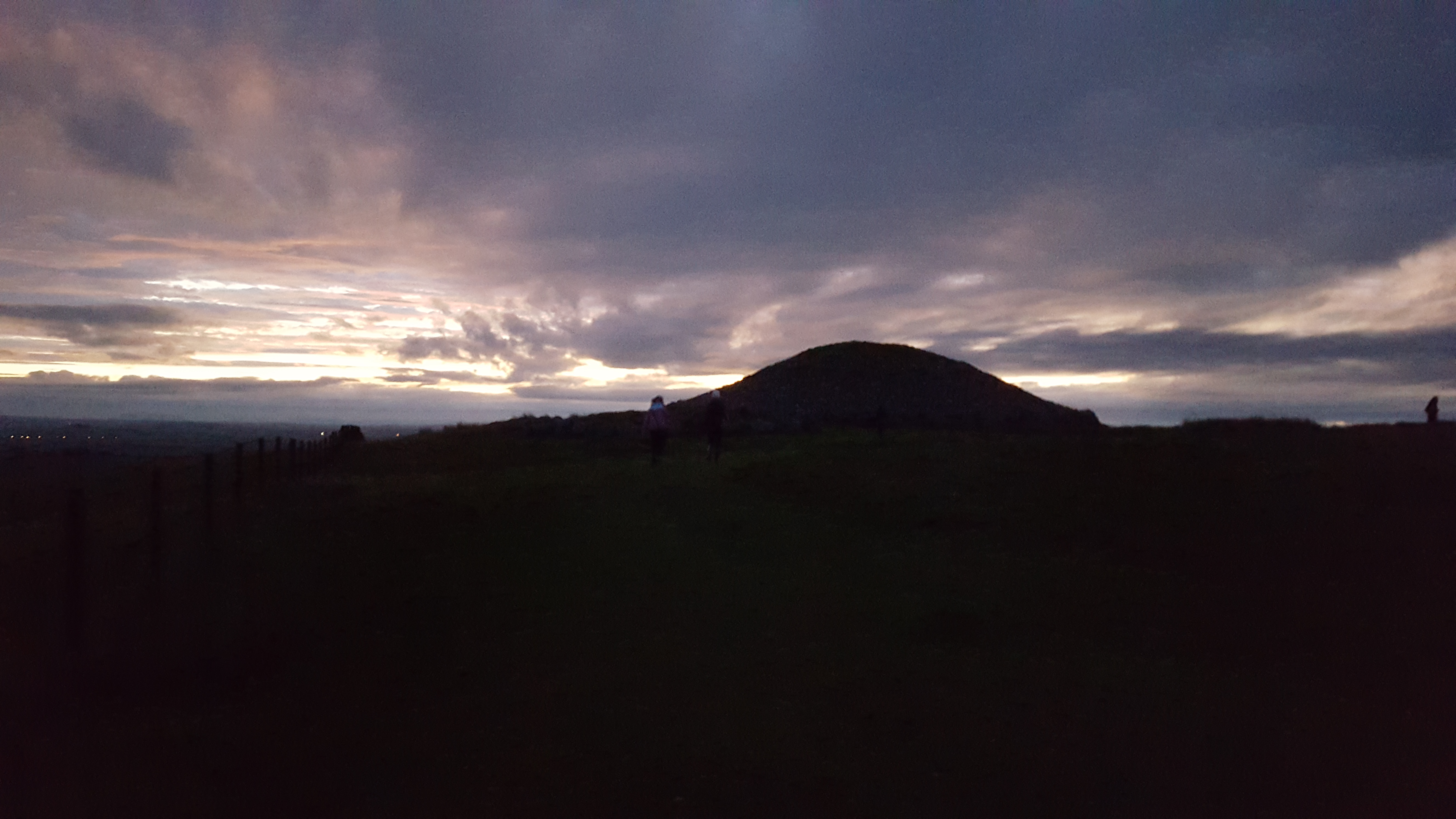
A full cycle around the sun brings us back into the dark
It’s a year since I started H A G. Excursions into Darkness was my first ever newsletter, but I never sent it out, so you won’t have read it. It’s as relevant to me now, though, as it was when I first wrote it.
I think of darkness as a female space and a force for good, for without it, there can be no light: light emerges from the blackness of the universe in the creation of stars and suns; from the earth in the form of seedlings, as new life from the womb, and as the fiery arrow of Imbas from our minds.
We should not fear it, but we do need to learn how to tend it. There is danger in equating darkness with bad things; war, violence, and the neglect of our planet are not a result of darkness, but of the activity and choices of humankind, and we need to take responsibility for that.

Who was the Mórrígan?
The Mórrígan is thought to be an Irish goddess of battle. She makes appearances in the Mythological and the Ulster Cycles of mythology, most notably in the tales of the Cath Muige Tuired Cunga (First Battle of Moytura) and Cath Maige Tuired (Second Battle of Moytura), and the Táin Bó Cúailnge (the Cattle Raid of Cooley).
She is believed to be the daughter of Ernmas, a ‘she-farmer’ of the Tuatha de Danann. Etymology translates her name as ‘the Great/ Phantom Queen’.
In the Mythological Cycle, she appears as part of Lugh’s war council before battle, where she describes her contribution to the conflict as pursuing, hunting and cutting out the enemy.
As the Dagda’s lover, she promises to go secretly into the enemy’s camp in order to ‘deprive [Indech, the enemy’s King] of the blood of his heart and the kidneys of his valour’; how she does this is not made explicit in the text, but as Indech lives on to join battle, clearly her work is intended to weaken and subdue rather than murder.
Disturbingly, she returns with two handfuls of Indech’s blood as proof of her task. In battle, she exhorts her warriors to battle-fever and sings battle-hymns to maintain morale. She also makes prophecies of the Danann’s victory.
In the earlier First Battle, her role is more of a magical one, as the above quote demonstrates, casting spells with her ‘sisters’ to cause terror in the enemy, to weaken, harass and confuse them.
It is in the Ulster Cycle, however, where the full range of her powers are revealed. Not only does she cast spells and prophesise, the warrior Cuchulainn’s doom, mostly, but she shape-shifts into various animal forms such as an eel, a red-eared heifer, a wolf, and a crow, but also between the various female incarnations of herself as a comely maiden, and old Hag.
In these tales, she is working on behalf of the mortal Connacht Queen Medb to subdue the unbeatable Ulster hero, Cuchulainn. Medb has her royal court at Cruachan in County Roscommon, also known as Rathgroghan, and it is here that the cave of Oweynagat is located, the entrance to the Otherworld through which the Mórrígan travels between the mortal and fairy realms.
It is interesting that Medb was born in this cave, a place associated very much with the feminine, and labelled by medieval authors as ‘the hell-mouth of Ireland’.
They believed at Samhain, the Mórrígan would emerge accompanied by herds of monstrous pigs and flocks of red-headed birds, all with the power to decay whatever their breath touched, and a triple-headed monster known as the Ellen Trechen, which at her bidding would lay waste to all of Ireland.

There are two types of Darkness that I know of.
What my excursions into darkness have shown me is that there are two types of dark: the external and the internal, and as a young person, I was afraid of the wrong one.
I was afraid of what the night hid – the physical obstacles and obstructions I could not see, the wild animals that might attack, the men who walked behind me, the thieves, rapists, murderers who used its cover to their advantage. I was afraid of how it distorted my perceptions and rendered me powerless and weak.
Of course, it wasn’t the dark that stole my agency, it was my own thoughts and fears. The dark is just an absence of light. And even then, it is rarely absolute.
The glimmering of stars, while dispassionate and remote, provide more than enough light to see by, and if you make the effort to learn how, are a presence by which you may orient yourself and follow your path. The moon is a beacon in the dark at all her stages of fullness, a gentle, benevolent companion in the night.
The darkness cannot be blamed for your missteps, for the night creatures’ reactions to your unexpected appearance, for the misdeeds of violent men. The dark is guileless, innocent, a fact of nature, a wonder of the planet we live on. The dark of night should be embraced as part of our physical experience of being, for although it has no physical form itself, it still impacts on ours.

So, I recently decided to test myself. A couple of weeks ago, I went for a walk alone in the dark. I admit I was nervous. To mitigate my fears, I set off at about 530pm, straight after work. Here in Ireland, in mid November, it is already dark by then.
I took a route I know well, my local 5km, a journey I took every day during our recent pandemic lockdown experience. I took my phone, for an added layer of security. I live out in the country, so there are no street lights. The stars and moon were obscured by a thick blanket of cloud, but the air was still and there was no rain.
I told myself I would only go a short distance, maybe a couple of kms and then return, but the evening was so fresh and lovely, I decided to walk the full 5km. I texted my husband so he knew where I was. The path was deserted. I met no humans, no animals, the birds were silent and sleeping.
I crossed the bridge, the stream gurgling below me as it always did. I was immersed in a kind of sensory deprivation. I could take no pleasure in the pastoral views as I usually did, or the plants and flowers I encountered along my route, because the darkness had pulled its curtain over them. The loudest sound was my feet on the path.
And even though I had no familiar constellations to guide me, no moon to light a silver path for me to follow, the darkness was not absolute. Once my eyes had become accustomed, I could sense a faint shimmering of light in the air, not enough to aid my sight, but enough to to comfort me. The street lights and human abundance of the town and city, I realised, gave me more cause for alarm than my lonely sojourn through the rural night.
But what of the internal darkness? That is something I have experienced more frequently the older I have become. Depression, low mood, mood swings, insidious voices and nasty thoughts that just don’t seem to come from me. You can call it what you like, but it’s just as real as the night, and fluctuates just as erratically as natural light levels. Internal darkness is also an absence of light, of hope, of inspiration. Like external dark, it has no physical form, but it impacts on the body in physiological ways, just as it impacts on the mind.
This is the greater challenge, and one I am still working on. There are no simple answers here, like going for a walk in the night, or descending into a deep hole in the earth’s crust. Not that those things were simple, but they were obvious. You face that fear by willingly entering into it. Room 101. The rats.
I had – still have, really – developed over the years three self-medication strategies for when the internal darkness overwhelms. I drink wine/ gin, I comfort-eat [everything], and I write. They are not solutions, and I don’t recommend them. They help in the moment, they ameliorate, they disguise the truth, but ultimately in the long term they make me feel worse.
Internal darkness is often something that cannot be vanquished alone. It took me until now, my 55th year on this earth to realise that. I’ve never been someone to ask for help with anything. But two things happened this year:
I almost threw away a year of intense study for my Masters in English just as I was about to embark on its key element, the thesis.
I took a very thorough medical offered by my employer which involved a questionnaire on my mental health, and to my absolute horror, it flagged the state of my mental health as ‘abnormal’. In big red letters.
I have never been a quitter. I am stubborn as a mule. Fiercely independent. Often foolishly so.
When I told my lecturer that I was giving up my Masters, she reached out to me with so much kindness that I was immediately humbled and grateful. I was not expecting such a response. It had not occurred to me that someone might care or want to help. That there might be other options. And although I felt like a failure, and weak for needing help, I decided in the end to complete my thesis. It was hard work but worth it. I was awarded a First Class Honours, and I graduate next spring.
The second issue is still in process. I fell apart for a few days, but then I made a plan that started with seeing my doctor. I have little more to say about that at this stage, except that it seems I am having trouble with perimenopause. And this may resonate with many women, because this subject, even today in 2022, is one that society doesn’t like to mention.
What the Mórrígan taught me about Darkness.
But going back to the Mórrígan; what have I learned from her? Well, for starters, she’s a shape-shifter; she takes many forms. This fits the obvious form of maid – mother – crone that most women go through. But she shows me that we can be who we want, that we are all complex manifestations of ourselves as we move through our existence, and that each aspect of our identity is valid and valuable.
Youth does not define me. I am not chasing it by altering my appearance to try and hold onto it as long as possible, like society tells us we must.
Motherhood does not define me. I am and always will be a mother to my children, but that is not all I am, and I have to dig deep and work hard to try and unearth this part of my individuality that I have buried for so long.
The grandmother archetype does not define me. My days of child-rearing are done, and I am excited to embark on building a life that centres my own desires. When grandchildren come, I will love them and mind them, but they will be a part of my life, not the whole of it.
At this stage, we must become our own archaeologists. Interpretation is key here, and we must pay attention to our intuition. It is not about returning to our past selves, or reinvention, a concept often bandied about with regard to women of a certain age.
It is simply re-engaging with who we always were, with that woman we never learned to express and have so long repressed in order to fulfil patriarchal expectations.
The Mórrígan’s shape-shifting took zoomorphic form in the guise of the crow/ rook/ raven, the eel, the wolf, the heifer. This is not something we mere mortals can do, but our imagination, meditation, our empathy can lead us to gain some understanding of more-than-human existence and perhaps learn from that.
After all, we all experience this world through our soft animal bodies; we share blood and flesh and bone. We have the same need for sustenance, shelter, warmth, love and companionship.
But the Mórrígan’s shapeshifting also took another form. Legend has it that she took another triple aspect – that of three ‘sisters’ named Badb, Nemain, and Anand (in some stories, Macha replaces Nemain).
While it is understood that these three sisters were known collectively as the Morrigna, or Mórrígan, the mythology tends to describe her as an individual being. It seems more logical to me that each ‘sister’ represents a different aspect of her identity as made up of her skills, such as battle prowess, foretelling the future, and poet.
We see this more clearly in the goddess Brigid, who is also made up of three ‘sisters’, in her case all of them called Brigid, who represent her skills in the forge as a blacksmith, her healing skills, and her poetic skills.
In entering the Mórrígan’s cave, I not only confronted my fears of the dark and caving, but I also willingly went to meet her. In the blackness, as I waited, I was forced to confront my limitations. What were my skills, my three aspects, if any?
I have returned to visit Oweynaghat every year since that first occasion, except for during the lockdown. I am always excited by it, and have learned a lot about myself.
Sometimes, it is necessary to step outside our comfort zone and face our fears. If you are embarking on such a journey, please make sure you do so in a safe and measured way. Watch out for the people who can guide you, they will stray across your path unexpectedly, and you don’t want to miss them. Realise your worth as a human being, and never be afraid to seek help when you need it.
We are entering our wisdom years. Let’s make the most of them. Thank you for reading. Don’t be shy, leave me a comment, I love to hear from you. And don’t forget to ‘like’ and share! Go raibh maith agat agus grá,


Hey… let's talk!