The meaning of the solstice in the modern world
On this morning of winter solstice, the rain is falling and the wild wind is raging around the hill where I live, and I think of our ancestors; on a morning such as this, would they have still gone to their hilltops to await the sun, knowing that all they were likely to see is a murky grey swimming stain of light that barely marks the transition between night and day. What is important? The appearance of the sun, the performing of ritual, or the act of faith that takes us up that hill on a wild wet morning?

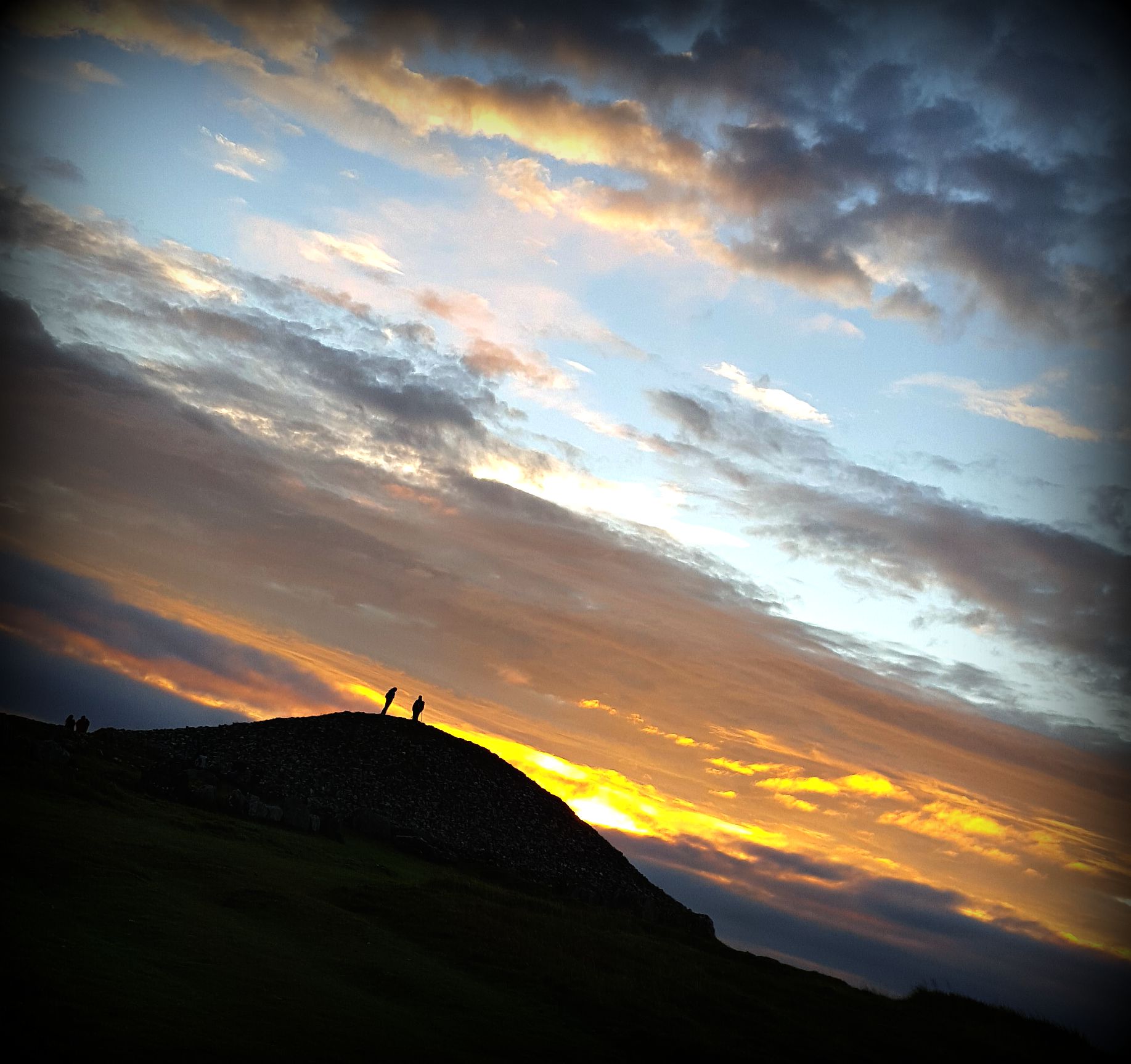
Although I have visited various sacred sites to experience the sun rise, it is not a regular ritual for me, partly because of the practicality of caring for Carys. Also, and this may seem trivial, but I’m not good in crowds. I need thinking space and quiet, and I accept this about myself now. On the occasions when I have joined groups, at Cairn T at Loughcrew, for example, I did not enter the chamber to witness the arrival of the sun because the space was too small for everyone to be inside for that special moment. I went in before. Only once have I been inside a cairn and witnessed the sun pierce the darkness, and I can truly say it was an emotional and inspiring experience.

Newgrange is famous for its sun alignment at the winter solstice. It’s incredible to me that something so sensorially imperceptible as that ‘standing still’ moment of the sun was known and understood and celebrated by our ancestors, and that they went to such extraordinary lengths to build these complex structures in order to capture, and study that moment every year.
The space inside Newgrange is not large; who would have entered to witness this spectacle? Most probably the druids and maybe the elites, while the rest of the community that built the monument waited outside. And what did it portend? The benevolence of the gods, fertility of the land and the women, a year of plenty? Maybe. We don’t really know for certain. And how would they have interpreted the ‘no-show’ of the sun on wet and wild days like today?
In the 1970s, these sacred places were popularly thought of as ‘womb tombs’, with the long entrance passage representing the birth canal and the mound likened to the pregnant belly. The sun was seen as the male force penetrating the dark female energy within the mound, or womb. So they were all about fertility, yet they were still thought of as places of the dead. Tombs. Where the dead were brought to return to mother earth. Their remains decomposing and so nourishing the earth and therefore ensuring, or even ‘insuring’, the fertility of land and plant and animal and human.
This idea seems to have fallen out of favour in preference of the sites’ association with the skies. And, no disrespect, but this seems a very male, and very narrow, and very modern, restrictive interpretation to me.
My own view is that these sites were built by peoples who celebrated not just death, not just the stars, but also life, and birth. That they were possibly even birthing centres. Why would they not? Are not these things of equal fundamental importance to all beings? When I look at the carvings on the stone in cairn T at Loughcrew, I understand when people see them as stars, and suns, the oval ones as galaxies, and so on, because I see that too.
But I also see cells. I see eggs and sperm. Maybe even wombs and vulvas. If we’re talking fertility, they could also be seen as flowers, leaves, seeds, pollen (plant sperm).
Patriarchal societies are not interested in seeing this when they look back on their (male) ancestors. They prefer to think of their male ancestors as being primarily concerned with the stars (science). And politics, and battles.
Undoubtedly, our ancestors were concerned with these things and more besides, because they were complex beings, just as we are today. The use of these megalithic centres was likely then to be multivarious.
What do you see when you look at this image? (Tell me in the comments.)

But that aside, these liminal moments and spaces also remind us of the interplay of dark and light within us. We are, each of us, a complex cosmos filled with light and dark, the fiery arrow of inspiration and matter.
Carl Sagan said, we are made of star stuff. And we matter. As we hang in the balance of seasons today, in this pause between the eternal sway of light, back and forth, this is what I will be pondering – how can we embody the light in the world today?
Wherever you are in the world, whatever and however you celebrate at this time of year, I hope you stay safe and well and warm and happy.
With the season’s blessings, and much grá,


Hey… let’s talk!