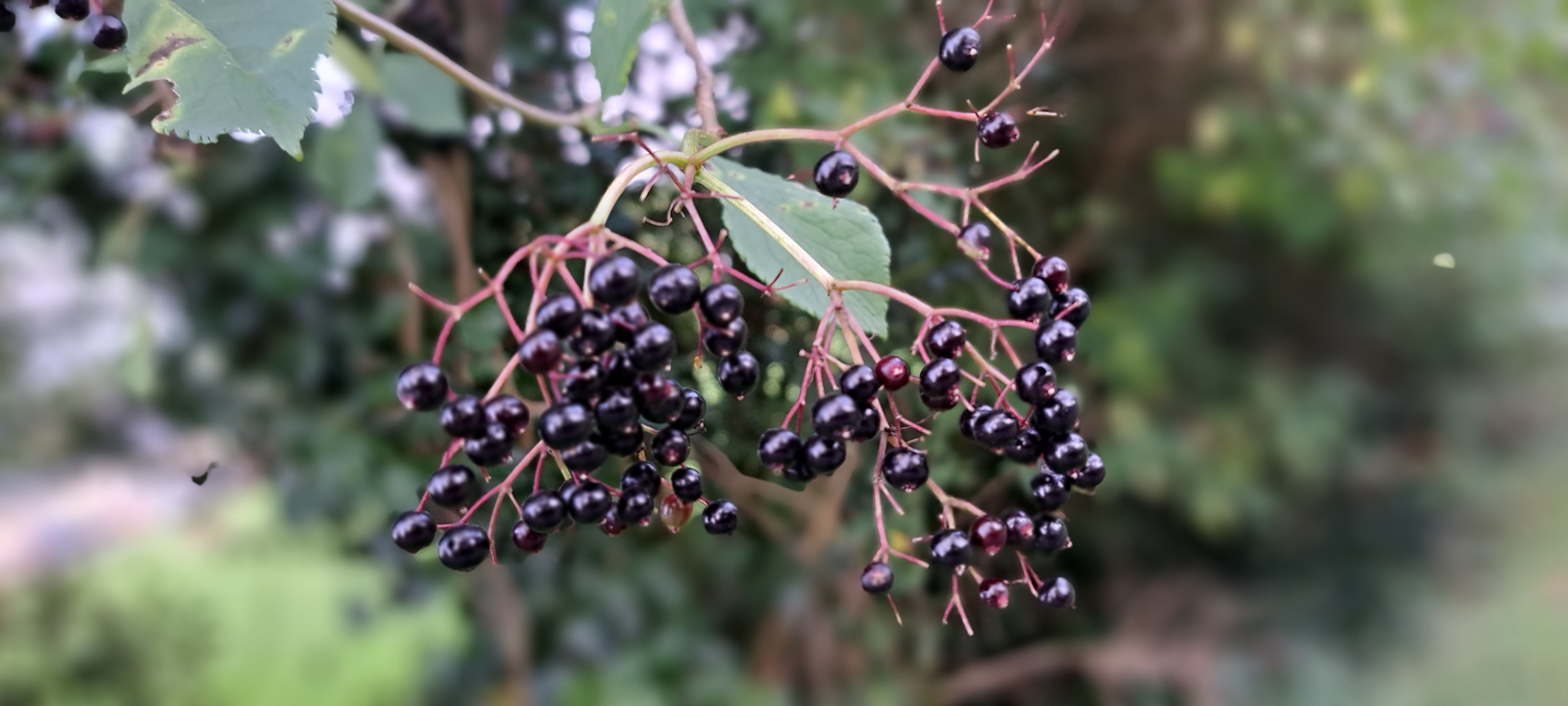
Clusters of purple-black tiny elderberries hanging from red stems under a branch

and how to make delicious health-boosting Elderberry syrup


Berry Confusion

The first time I encountered elderberry, I didn’t know what it was. I was mooching around the old abandoned site of Fore Abbey, when I almost stepped on a cluster of tiny purple-black berries held on a spray of deep red stalks. I picked it up, puzzled, and laid it on top of a stone wall where it glistened in the sun, oozing juice. I was fascinated, but I left it for the birds.

The following spring, I noticed sprays of tiny white flowers in the hedges, held together in masses as big and flat as plates. I didn’t connect the two. I remember trying to describe them over the phone to Jenni, who knew about these things, but my incoherent description just puzzled her, and we were both stumped. Now, many years later, I know that they are parts of the same plant – Elder.

Wild gifts from the hedgerow – elderberry, wild rosehip, blackberry, rosa rugosa hips, and naturalised crocosmia flowers © Ali Isaac

Human Interaction

In early September, there was abundance in the hedges. Every walk brought me gifts from nature – flowers to decorate my home, fruits and nuts and leaves to be eaten. I must admit, I became a little complacent. I went on holiday, and when I came back two weeks later, everything was gone.

Fair enough if it was left to the wild things that rely on it, or shared with fellow foragers. But that was not what happened. The elder trees had been cut back prematurely into stumps by an overzealous landowner. And the stretch of path where once I had gathered wild raspberries and horse-chestnuts had their verges completely removed and replaced with a wide ugly stretch of tarmac, big as a car park.

A farmer’s tractor has to access his fields, I know, and nature is resilient. But I can’t stop thinking of all that bounty/ beauty destroyed, all the little animals and bugs that found shelter and sustenance in the low tangle of undergrowth beneath those hedges now homeless, or probably dead. A small pocket of natural wilderness, a perfect mini eco-system surviving and thriving in a world that is ever more needful of it, wiped out. And yes, I am grieving.

Earlier in the year, I saved seeds from some of the wild plants growing in these hedges. I wish now that I had saved more, that I had gathered more elderberries and and conkers and stuck them in my freezer for processing later. I know now that walking the hedges, appreciating them and learning from them is not enough. If they go the way everything else is going, they too might soon be gone.

My house is situated on almost an acre of land. I have given most of it back to nature. I have planted hedges, woodland, and bankings with native plants, and I let the grass grow and the leaves lie. My house sits on a hilltop, half of which was scraped away to make space for it, long before we came to live here. That means all the top soil, the natural seedbank, was removed in the process. I’ve waited patiently, and the wild plants are cautiously, slowly returning. But I think they need a bigger welcome, a helping hand.

Negative Reciprocity

In her book, Braiding Sweetgrass, Robin Wall Kimmerer writes about the importance of reciprocity, about how animal and human and plant have evolved on the land together, how their places in the ecosystem are interconnected, how balance and all our wellbeing rests on our interactions.

Human activity in the landscape can be destructive and thoughtless, but it can also be positive and beneficial. She describes how the sweetgrass thrives on the interaction of humankind rather than being left to itself. The harvesting of sweetgrass thins the plants, giving them more space for receiving air and light, less competition for nutrients, less opportunity for disease to spread. The land needs human and sweetgrass, and human and sweetgrass need each other.

And this is where we are now. In negative reciprocity.

Humans have plundered the earth’s resources to the point of ecosystem collapse. And still keep on doing it. And no COP meeting, no geopolitical agreement, no government or law holds these humans to account.

Faithful to the Land

A couple of weeks ago, I stood in the pitch black of the Morrigan’s cave, and thought of all the atrocities going on around me in and to the world. I wanted to stop feeling helpless, hopeless. I wanted to do some small thing to help in some way. I asked the universe, the Morrigan, anyone who was listening, what could I do, and I recieved a clear message: be faithful to the land. It was not what I expected to hear. I didn’t know then what it meant, or how ‘being faithful to the land’ could possibly help, but now I’m starting to.

It starts right here with this patch of land where I live. I have never felt I own this land, even though it says so on the deeds. I co-habit here, and now this land needs more direct intervention from me. I know who my wild plant neighbours are, but this year in particular they have been at the mercy of local landowners. I can’t rely on their presence as a given.

I need to offer them space and shelter right here where no human will harm them. It’s time to bring them home. I can’t stop farmers from the massacre of their hedges or poluting their land with fertilizers, but I can take care of my own patch.

Faithful means ‘to be loyal and steadfast’. That I can do.

Clusters of purple-black tiny elderberries hanging from red stems under a branch
Elderberries (c) Ali Isaac

How to make delicious health-boosting elderberry syrup and why you should

  • Going out for a walk to forage for elderberries is fun, good exercise, and your berries are free.

  • Elderberry syrup is so quick, easy and rewarding to make.

  • Elderberries are bursting with health- and immune-boosting properties.

  • Whipping up a batch of elderberry syrup in the autumn will see you and your family through a winter of coughs and colds.

  • It’s a natural, eco-friendly medicine that you know contains no sugar and none of the nasty chemical additives and preservatives that pollute so many modern foodstuffs, because you made it yourself.

Recipe and Method

First, gather your elderberries. Remove them from the stalks using a fork to ‘comb’ through them. If they are ripe, the tiny berries will easily pop off the stem. Dispose of the stems, as they are toxic, and don’t be tempted to eat any of those shiny purple berries raw, either. They need to be cooked to be edible.

Add the berries to a pan and cover with water. When boiling, turn the heat down and allow to simmer gently for about 15 to 30 minutes, until the berries have softened. You can mash them lightly to release the juice. When the liquid has reduced a little into a nice syrupy texture, turn off the heat and let cool for a few minutes.

While still warm, strain the liquid and berries through a muslin or nut milk bag into a jug, squeezing the cloth to extract as much of the liquid as possible. Be careful, as any splashes might stain.

Now add your local raw honey to taste (I only add 2 tablespoons and that is sweet enough for me), and stir until the honey has dissolved. Allow your elderberry syrup to cool completely before pouring into bottles. Keep in the fridge, or freeze. That’s all there is to it, and no tooth-rotting sugar or nasty preservatives.

NB. Most recipes require large amounts of sugar, but this is totally unneccessary and doesn’t affect the syrup’s texture. Also, most recipes will tell you to discard or compost the berry pulp after straining, but don’t do this! You can add it to your apple pie or crumble, make a cake or cheesecake with it, or turn it into jam, which is what I did, and it was delicious.

An adult can take up to 15mls of elderberry syrup up to 4 times a day.

PLate with 2 slices of toast spread with purple jam, beside a small glass jus containing a dark purple liquid, and a jar with the lid off showing purple-black jam, all sitting in a wooden work surface
Homemade elderberry syrup and jam (c) Ali Isaac

Benefits of Elderberry Syrup

  • Effective treatment for colds and flu.

  • Can be taken daily as a preventative, or at the onset of illness to reduce its duration.

  • Contains phenols and flavenols which can help to reduce oxidative stress in the body that can lead to diseases such as type 2 diabetes and cancer.

  • Rich in Vitamin C and fibre.

  • Supports the immune system by helping to increase the supply of white blood cells.

  • Rich in anthocyanins, an antioxidant compound that gives the berry its colour and provides a powerful anti-inflammatory effect.

NB. All parts of the elder plant, except for the flowers, are toxic if eaten raw. Please only consume after cooking.

To find out more about the health benefits of elderberry, check the reference section below.

Here you can find out how to make elderflower cordial from the flowers that bloom in May

Tell me, have you ever made elderberry syrup? What home-made natural remedies do you swear by? Would you like to know what other natural products I regularly make and use? Please tell me in the comments.

With wishes of abundant health and good cheer throughout this dark half of the year and much Grá,
My signiture, 'Ali'

CITATIONS
 

17 responses to “Plant Generosity & Negative Reciprocity”

  1. Whitney McKnight avatar
    Whitney McKnight

    This is lovely, Ali. Thank you.

  2. Ali Isaac avatar
    Ali Isaac

    Hi Robin, I think when a plant becomes invasive, if its not native, it should be removed, as they end up doing more harm than good. Otherwise, I think we should make every effort to use as much of the invasive plant as possible, even if that means controlling it by using it for firewood. Delia of the greenwood uses invasive kudzu for weaving, and she makes amazing stuff with it. If it is native, then it’s just thriving in its natural habitat. But if its also taking over, then it might just be asking for a bit of human help. I find that here with the willow, and blackberry.

  3. Ali Isaac avatar
    Ali Isaac

    Maybe one day I’ll get to walk with you across your landholding… it sounds idyllic! I get you re the sterile gardens. I shudder when I see fake grass being laid. Exactly this re the thoughtlessness of farmers… we think they are closer to the land than we are, and many are, but equally as many only see the dollar signs.

  4. Robin Heart Shepperd avatar
    Robin Heart Shepperd

    Here in Central Texas, elderberries can be quite invasive. Bart grows a patch, and I’ve been privy to the bounty. They were done by the end of spring. I made an elderberry syrup and added honey, but also brandy. With brandy, it doesn’t have to be refrigerated, and I can keep it for many months.

    I understand your angst regarding the unconscious cut-backs done on the land. Mother allowed the rancher next door to clear 20 acres of her land to rent and I cried. He wanted to graze cattle, but heavens, couldn’t he leave some nice oaks for the cattle to get to shade in the heat of the summer? What an idiot.

    Bart has 1/3 acre and he has planted a surprising number of natives. On the barren land out from San Marcos, I planted 10 native trees and 9 native bushes. I am hoping that the new owners watered them in summer heat. In Austin, there is much more consciousness around planting natives, but not so much for surrounding areas. It distresses me.

    1. Ali Isaac avatar
      Ali Isaac

      Adding alcohol is great for preservation, I think that makes it a tincture. I hope the new owners of your old house took care of the trees you planted. I remember how hard it was for you to plant them, the gound was baked hard like clay, you told me. Having trees there would add so much pleasure to their use of the garden, drawing up moisture from the deep with their roots and offering shade in the summer. 💕

  5. Jane Dougherty avatar
    Jane Dougherty

    Thanks for writing this, Ali. It’s what I think too. We’re guardians, custodians, not landowners. I’m lucky to live on what was once a smallholding, about five acres of ancient meadow, hedges and trees along a stream. The surrounding land is partly cultivated, partly uncultivated woods and wild land. And in theory, no more of the land can be built on. But the contrast with our old place and the new houses down the lane closer to town is stark. The manicured lawns, swimming pools, round-up and strimmers, useless ornamental shrubs and hedges of green cement. Nothing lives in these gardens, not even the owners who never set foot in them. They’re a periurban desert. I know, we’re surrounded by countryside which isn’t intensely farmed, but the model of that ‘garden’ means death to all insect life, consequently there will be few birds, rodents, predators. Nothing except ride-on mowers. Just a patch of wild changes a lot. No, we change the course of geopolitics, but we can make out little bit of the world a kinder, friendlier place.
    PS My dad made elderberry wine.

    1. Ali Isaac avatar
      Ali Isaac

      Oh and kudos to your dad… elderberry wine sounds amazing! I confess to adding the odd splash of elderberry syrup to my G&T, now and again! Although I mostly don’t drink alcohol these days.

      1. Jane Dougherty avatar
        Jane Dougherty

        He used to get all four of us out with him, hauling great sacks of berries back through the fields. It’s a good thing the product was alcoholic, that’s all I can say. Killed all the bacteria that fermented in it!

      2. Ali Isaac avatar
        Ali Isaac

        Hahaha! That’s my excuse for drinking alcohol!

      3. Jane Dougherty avatar
        Jane Dougherty

        I don’t think I need one 🙂

      4. Ali Isaac avatar
        Ali Isaac

        😂😂😂

  6. Kelly Hargie avatar
    Kelly Hargie

    Wonderful words and thoughts as ever, Ali. Thank you 🙏 I too have been asking how I can make a difference, staying still long enough to hear the whispers. I don’t have land and the words that keep coming to me day and night are “start in the corner you find yourself”… real change happens at the grassroots level I believe, the ripples moving out into the world. We can only start where we are with hope. Loved your words this morning, so very grateful for them and for your beautiful heart. Together we can x

    1. Ali Isaac avatar
      Ali Isaac

      Thank you, Kelly. I love that you have also been asking how you can best show up to make a difference. Your experience sounds much like mine: a strong clear message, although the direction is vague. We are not being told what to do. The universe is trusting us to come to our senses and see for ourselves where that work can take place. I am here for those messages, for learning through experience not instructions. Thanks for reading and sharing your Imbas with us here, Kelly. 💕

  7. Catherine Rhatigan avatar
    Catherine Rhatigan

    Great article about the wild flowers. Couldn’t agree more and leaving my sligo garden like that too. Love elder trees. They’re traditionally seen as protector trees and you’re indeed blessed if one plants itself near you. We have one that self seeded near the door in our tiny suburban garden. It’s treated like a celebrity, by us. I just freeze the elder berries straight fro the tree, then put a handful in a sieve, mash with a fork, pour in boiling water and add honey, and that’s my miracle cure. Loving the dark days. You take care, C

    1. Ali Isaac avatar
      Ali Isaac

      Lol…imagining you treating this Elder as a celebrity! I am in awe of all the plants that have seeded themselves into my garden, they are welcome here. Some of them are going a bit too far tbh, they need to learn the lesson of sharing space! Elder, sadly, is not one of them, and there aren’t many of them in my area, which is why the row I found this spring really mattered to me, and why I am so devastated at how drastically they were chopped back. I’m sure yours is rewarding you with lots of blossom and fruit. I love that you freeze your berries for when you need them. I have now learned the hard way that I should have done the same. Also learned that I can’t take nature’s generosity for granted. Who knows if the Elder will be able to recover for next season… and maybe that’s why I never noticed them before, because they were cut back so aggressively in the past. I also love the simplicity of your syrup recipe, it doesn’t need to be any more than that. Why do some people have to over-complicate things, and fill up their recipes with junk, like a ton of sugar? Thanks for being here, and thanks for sharing your wisdom. 💕

  8. Sue Driscoll avatar
    Sue Driscoll

    I make elderberry juice and either make syrup or, this year, I used it in eldeberry kombucha! I’m lucky to live in Vermont where we have wild blackberries and elderberries, also apple trees gone wild. I was just talking today about how we need to live with our black bear neighbors – there’s a mama and two cubs living in the woods – and as humans it’s our responsibility to contain our smelly attractants to limit the bear visits. They were here first!

    1. Ali Isaac avatar
      Ali Isaac

      Oh my word, you have BEARS? We used to have bears in Ireland a long time ago. There is a cave called Aillwee in Co Clare where you can still see the depressions made in the dust where our native brown bears settled down to sleep between 10, 000 and 4,500 years ago! I can’t imagine what it must be like to live so closely with such mighty creatures. They have such bad press. I’m sure I would be afraid. But at the end of the day, that Mama is just trying to feed and protect her babies. I love that you are doing everything you can to support that by not leaving any human stuff lying around that might attract bears. I’m sure it’s not easy, though, but if everyone did the same, there would probably be fewer incidents. Easy for me to say, when I don’t have to live near them, though. I also love your use of the Elderberry and other fruits growing wild in your area. I find there’s something so satisfying in accepting nature’s wild gifts snd working with nature for our own health and wellbeing, and that of the land. Thank you for reading and sharing your wisdom here! 💚

Hey… let's talk!

Discover more from Ali Isaac

Subscribe now to keep reading and get access to the full archive.

Continue reading