Sovereignty – a noun meaning “the power or authority to rule”1
Who is the Sovereignty Goddess?
She is thought to represent the land and the divine right to rule over that land. A would-be king was expected to unite with her in order to legitimise his right to the kingship. Feasting would be involved, and sex.
Another important feature was the offering of a drink, water or alcohol depending on the tale, by the goddess to the king. By uniting with the goddess, the king was ‘marrying’ the land, and while he flourished, so would the land, and therefore by extension, so too would the people.
According to Muireann ní Bhrolcháin,2 the sovereignty goddess could manifest in three ways, and an element of transformation was always involved:
She appears to the king as an ugly old hag, who becomes young and beautiful when he completes the challenge she sets him, usually sex or a full-on kiss, at least.
She appears as a woman who loses her mind and then regains it.
She appears as a woman who loses her status, but regains it.
The following selection of stories from early Irish manuscripts are all thought to fall within the sovereignty goddess genre, yet whilst they meet some of Ní Brolcháin’s requirements, they don’t all serve to confer the right of kingship.
Niall of the Nine Hostages
In the Echtra Mac nEchach (“the adventures of the sons of Eochaid”), Niall Noígíallach (of the nine hostages) was out hunting with his many brothers one day, when they stopped at a well to draw water. The well, however, was guarded by an ugly old hag who demanded payment of a kiss. Fergus and Ailill were disgusted, and refused. Fiachrae gives her a quick peck on the cheek, but she was not satisfied by his chaste offering.
According to Whitley Stokes’ translation, this is what she looked like:
“Every joint and limb of her, from the top of her head to the earth, was as black as coal. Like the tail of a wild horse was the gray bristly mane that came through the upper part of her head-crown. The green branch of an oak in bearing would be severed by the sickle of green teeth that lay in her head and reached to her ears. Dark smoky eyes she had: a nose crooked and hollow. She had a middle fibrous, spotted with pustules, diseased, and shins distorted and awry. Her ankles were thick, her shoulder blades were broad, her knees were big, and her nails were green. Loathsome in sooth was the hag’s appearance.”
Charming!
Undeterred, Niall launches a no-holds-barred, full-on snog on the old woman, even offering to sleep with her though she only asked for a kiss, and thus gratified, she transforms into a beautiful young woman and bestows upon him and twenty-six future generations of his descendants the right to the high kingship of Ireland.
Fiachrae is also rewarded; two of his descendants enjoy the high kingship of Ireland, too. Note though, that the beverage offered by the goddess of sovereignty is but a humble sip of water, not an alcoholic drink.
Niall is a semi-historical person, founder of the illustrious and powerful line of the Uí Néill’s (O’Neill’s) which dominated Ireland throughout the early medieval period, although the Annals can’t agree on the actual period of his reign, and neither can the academics.
His life is now shrouded in legend and myth. He was said to be a high king of Ireland, possibly during the fourth or fifth centuries, however this is likely to be untrue, as it has now been established that the office of high kingship did not exist before the ninth century.
According to Geoffrey Keating, Niall led raiding parties on Britain (and/ or Brittany), and it was on one of these raids that St Patrick was abducted (along with his sisters, Lupida and Darerca, apparently, whom of course have been dropped from the narrative). 3
Conn of the Hundred Battles
In Baile in Scáil (The Phantom’s Vision), Conn Cétchathach finds himself entering the Otherworld through mist. There he encounters the God Lugh, one-time high king of the Tuatha de Danann. With him is a beautiful woman bearing a golden goblet filled from a gold and silver barrel holding ‘red ale’. She asks Lugh to whom she is to offer the cup, and he tells her to give it to Conn, who drinks whilst Lugh then goes on to recite a long list of Conn’s descendants who will become high king after him. 4
Here, the woman does not fit any of Ní Bhrolcháin’s three categories. She is already beautiful, has not lost her mind, and as consort of Lugh possesses high status. Feasting and drink is involved, but not sex. The drink is not water but ale. And although the drink is given by the woman, the right of kingship is bestowed by Lugh. Not only that, but they have passed through the misty liminal margin between the mortal and magical worlds, the whole ceremony taking place in the Otherworld.
Like Niall, Conn is also a semi-legendary High King, and is in fact descended from him. The theme of the sovereignty goddess is then perhaps a trope commonly used to legitimise the rise of Ui Neill kings.
Mór Muman
In Mór Muman Aided Cuanach meic Ailchine (Mór Muman and the death of Cuanu mac Ailchine), Muman lost her mind after hearing voices in the air, causing her to escape by jumping over the embankment which surrounded her home. Such leaping is typically a sign of mourning, loss or madness in early Irish literature. 5
Mór wandered Ireland for two years, crazed and “blackened by sun and wind, in rags and marshes”. 6 Once “thought so beautiful that every woman in Ireland was compared to her”, 7 her appearance deteriorated so much that no one recognised her. Finally she came to Cashel, where she began minding King Fingen mac Aeda’s sheep.
Fingen’s wife mocked the new shepherdess, daring her husband to sleep with her. He obliged, and afterwards took Mór as his new wife, giving her a “purple cloak and queenly brooch”. Her sanity was restored and she duly produced a male heir, Sechnasach. When Fingen died, Mór married another king named Cathal, and after him, another king of the Eoganacht.
Interestingly, there is also a tale where she squatted to relieve herself while out walking the land, and her great streams of urine carved out the valleys and mountains of Munster. There is a similar story about Queen Medb. This shaping of the landscape by a female deity or high-ranking elite is reminiscent of the Cailleach and her influence on the land.
Mór was the daughter of a seventh-century historical king known as Aed Bennan, of the Eoganacht Locha Léin. Her name means ‘great mother’ and the province of Munster was named after her. According to Ní Bhrolcháin, Mor’s fertility and her multiple marriages indicate a sovereignty goddess role, although Mór was a mortal, not an Otherworldly figure.
Historically, high-status women were often remarried more than once, usually to cement political alliances, so I am not convinced by this argument. In any case, Fingen was already king, as were her following two husbands. Mór’s presence in the tale does not confer sovereignty.
Mis and Dubh Rois
Mis’s father was killed at the Battle of Ventry (so he fought with Fionn mac Cumhaill, which places this story in the third century). When she found her father’s body, she was so overcome by his brutal death (and probably the carnage of the battlefield) that she lost her sanity and drank his blood.
She grew whiskers, fur and feathers, thus entering a non-human state, and rampaged around the area of the Sliabh Mis mountains, leaping into trees, running as fast as the wind, killing animal and human alike, and eating their raw flesh, so that Feidhlimidh, the king, sent his harper, Dubh Rois, to capture her.
Dubh Rois knew a thing or two about wild women, and he decided the best way to win her round was with gold, music and sex. He laid down on the mountainside, loosened his trousers to expose his privates, hoisted up his harp, and began to play. Seduced by his harp playing at first, Mis soon became more interested in him.
“A glance she gave, and she saw his nakedness and his playthings, and she said: “What are these?” she asked of his bag and his little eggs, and he told her.
“What is this?” she asked of the other thing that she saw.
“That is a branch of the trick,” he said.
“I don’t remember that,” she said. “My father did not have such a thing.” “Branch of the trick,” she said again. “What is the trick?”
“Sit beside me,” he said,” and I will perform the trick of that branch for you.”
“I will,” she said, “and stay beside me.”
“I will,” he said. He lay and slept with her and she said: “Ho ho, a good trick. Do it again!”
“I will,” he said. “But I will play the harp for you first.”
“Never mind the harp,” she said. “Do the trick again.” 8
Dubh Rois then builds a fullachta fiadh in which he boils deer meat to feed her, and gives her bread he has brought with him. Then he melts deer fat in the warm water of the fullachta and bathes her in it. These actions remind her of how she used to live; they serve to re-civilise Mis and return her from her wildness to sanity. The couple go on to marry and have children together.
The Sovereignty Goddess as the Cailleach
Maybe I’m a bit late to the party, but it had never occurred to me before I began working on this text that an Cailleach and the sovereignty goddess could be one and the same, or at least a double aspect of the same entity. Geróid Ó Crualaoich spotted it in his The Book of the Cailleach, when he writes
The Cailleach… regarded as the shaper who has formed the features of the landscape… becomes identified… as a royal sovereignty principle in terms of the political ideology of the ruling dynastic lineages. In the course of time… [she] undergoes transformation into that of the sovereignty queen and suffers stigma and displacement in the course of the development of the patriarchal and Christian cultural world of the later Irish middle ages.
Somehow, I must have leapt over that part of his book, and it didn’t lodge until my second reading. When I am reading a good book, sometimes my eyes gallop ahead and my brain can’t keep up.
There is so much more I want to discuss with you about the sovereignty goddess: the role of the female in the building of nation states, eg Britannia, Colombia, Hibernia, all modern sovereignty goddesses if ever I saw one, albeit created to please the male gaze; Mother Ireland and Kathleen ní Houlihan; the Aisling and the Spéirbhan, or sky woman, heiros gamos, so beloved of sensationalists, and of course, Giraldus Cambrensis, and his deliberately misleading interpretation of Irish kingship rites…
But this post is already too long, so perhaps we need a Sovereignty Goddess Part Two? Let me know in the comments!
It amazes me that in a patriarchal society kings required the blessing of a woman before they could rule, and that they had to prove to her how far they were willing to go for the honour of the role. Of course that was many hundreds of years ago and monarchies, where they remain, have deferred to the democratic powers of governments.
Governments and kings do not depend on my blessing. My personal sovereignty works at grass roots level, building the life which feels authentic to me, most nourishing to my family, building habits and traditions and raising awareness amongst those close to me that are all-inclusive and which honour the earth.
How many caileacha like me are working in the same way, their areas of influence intersecting with my own, snapping together like synapses, creating a ring of energy and light of protection around everything we care about.
We are going back to the old ways to protect the future.

Calling all Grey-Haired Rebels!
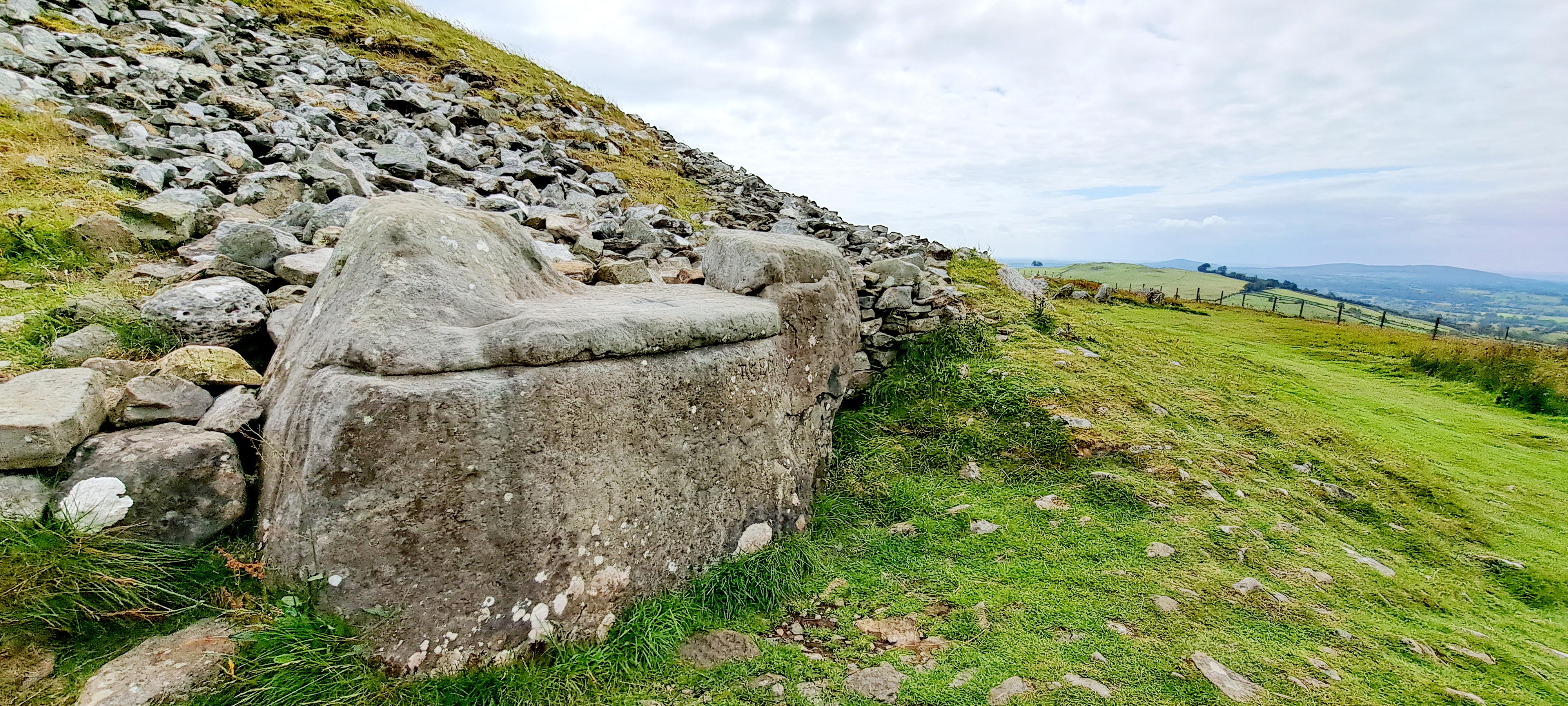
In 2017, the Office for Public Works shut Cairn T at Loughcrew, the Hag’s Mountain, because they said it was no longer structurally sound. Cairn T has survived perfectly well for thousands of years; it is the needless intervention of an air vent and concrete which has caused its decay.
Prior to the closure, anyone could borrow the key and enter the chamber. No harm was ever done. The closure was only meant to be temporary, but here we are in 2026, no survey has been done, no remedial action taken, the cairn remains shut. There is no transparency about the future of this wondrous ancient site.
If you care about the seat of the Cailleach at Loughcrew, reach out to the OPW and the National Monument Service to put pressure on them to care for this irreplaceable gift from the past. I am asking all our grey-haired rebels to play their part and remember their power. Let’s get to work. You know what to do.
Office of Public Works, Address: Jonathan Swift Street, Trim, Co Meath, C15 NX36 Website:www.gov.ie/opw/ Email:info@opw.ie Phone number:0469422000
National Monuments Service, Department of Housing, Local Government and Heritage, Custom House, Dublin 1. Tel:085 8049231 Email:nationalmonuments@housing.gov.ie
Within the NMS a number of individual units carry out critical functions in relation to the protection and management of our archaeological resource. The contact details for these units can be found at the following links:
Thank you for being here! If you enjoyed this post, please like, share, and if you’re not already, please subscribe. With grá mór,

CITATIONS
Definition of sovereignty from the Cambridge Academic Content Dictionary © Cambridge University Press
My own notes from lectures, ‘The Cultural Heritage of ‘Royal Sites’, Maynooth University.

Hey… let's talk!