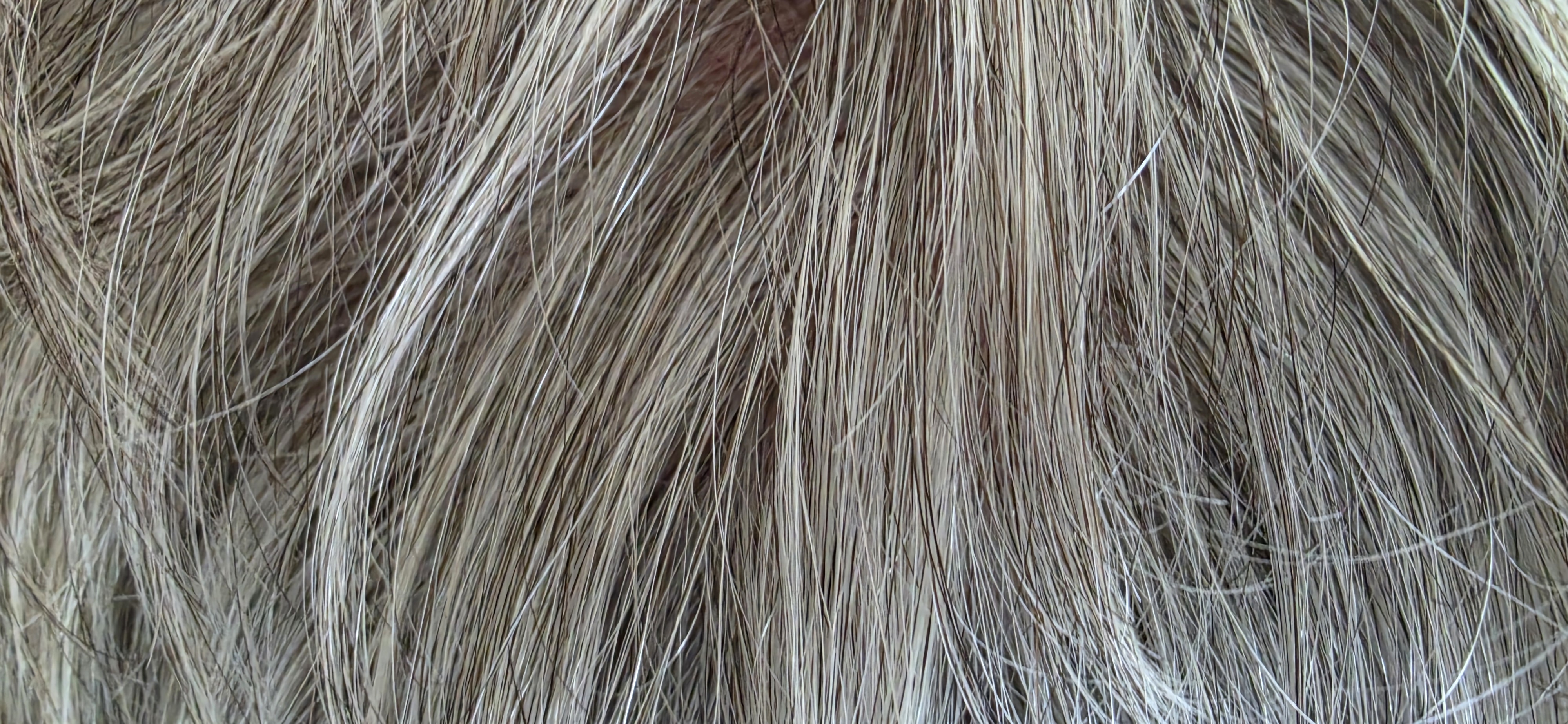
And the power of going grey
We’re back to Herself, the Cailleach, this month. April should feel like Spring, but this year in Ireland, at least, the Cailleach is not yet ready to relinquish her grip on all she has produced and nurtured throughout the Winter to the Foster-Mother, Brigid.
Who can blame her?
Like Lugh, the child comes to love the Foster-Mother, and memories of the Birth-Mother grow dim. But Brigid and the Cailleach work together to provide all the child needs. Birth-Mother is old and tired, her great work unseen, unappreciated. How blind and ungrateful we have become.
Grey hair on a woman . . . produce[s] one of the least desirable personas in Western society – an old woman. 1
A. Holland & C. Simmons
All we know about An Cailleach is that she is old. We have no description, no backstory, no lineage. She simply exists in the way that the landscape exists – ancient, immutable, caught in the cycle of the seasons.
Sometimes, the land retreats behind a soft veil of mist. Similarly, some stories mention the old woman’s grey veil. But the veil is a human construct, and the old woman is nature personified. Perhaps the grey veil is a metaphor for something else entirely.
A Quick Summary of the Multi-Faceted Cailleach
Before we dive into this month’s topic, which I feel the Cailleach embodies so perfectly, here is a quick recap of five aspects of her persona we have examined in previous posts. An Cailleach appears as a mysterious and shadowy figure hovering around the edges of Irish folklore and myth. Although little is known about her, she wears many faces and carries many names.
Today, the word Cailleach is understood to mean ‘hag’, or ‘crone’, yet in Old Gaelic it actually means ‘veiled one’. This conjures up images of early Medieval Christian nuns, women who sacrificed a normal life (ie marriages as political/ social/ financial alliances) in order to ‘take the veil’ and commit themselves to the service of God.
It is also possible that the word has more ancient origins and could refer to the female Druids of pre-Christian Ireland. I have not seen the evidence to support this theory, but the veiling of women, it seems to me, arose with the patriarchy, and whilst patriarchal societies have existed throughout history across geo-political boundaries, in the west it was particularly brutal during the medieval and early modern periods.
The Goddess in the Landscape
The Cailleach lends her name to many features of the Irish landscape. For example, Loughcrew is known in Irish as Sliabh na Caillí, meaning ‘the Hag’s Mountain’. It is said that the cairns were formed as the Cailleach leaped between the three hill-tops, carrying rocks in her apron. When she stumbled and fell to her death, the rocks tumbled out creating the ancient ruined structures which cluster upon the three hills as we know them today.
She is also remembered at the Cliffs of Moher, County Clare, where one cliff is named ‘the Hag’s Head’ (Ceann Caillí in Irish); also at ‘the Hag’s Cliff’ (Aill na Caillí) in County Galway; at the Calliagh Birra’s House, a cairn on Slieve-Gullion in Armagh; at the Labbacallee Wedge Tomb, or ‘the Hag’s Bed’ in County Cork (anglicised from Leabhadh Chailligh), and which is said to be her burial place (although she is also said to be buried at Loughcrew).
Despite the passing of centuries, the half-forgotten Queen is well commemorated in the naming of the landscape.
The Cliff-Top Queen
Some stories say that at the end of winter, the Cailleach turns into a great grey rock beside the sea. Others, that if she reaches the sea in time and bathes in it, she will not be turned to stone. There is a great deal of language relating to the sea, and much sea imagery in the poem The Lament of the Old Woman, corroborating her role as a creator of the landscape.
But why the sea in particular, and why the hilltops and cliffs?
The meeting of sea and shore (or sky and land) is a liminal space where magic can happen. Beyond the sea, over the ninth wave lies the way to the Sacred Isles, Manannán’s Land, the Otherworld. Where else might a seasonal Goddess go to rest after the ceaseless toil and hardship of winter, once she has relinquished her power to her opposing force?
Mistaken Identity
But who was she? A Goddess, a Queen, a witch, a mortal wise-woman? You can read my earlier posts to find out more about these aspects of her persona.
And why is she associated with so many passage tombs and cliffs?
Female deities are popularly associated with fertility, or sovereignty, yet the Cailleach is associated with the dark and decay of winter, and with the land particularly, in its barren state of wintry stasis. From the darkness of the womb, though, the light of life is born, and the dark, silent inner chamber of the cairn or mound can be likened to the womb, the entrance or exit passage associated with the birth canal. In fact, sometimes these burial spaces are actually referred to as ‘womb tombs’.
Perhaps the dead were carried into these tombs to the Cailleach to allow their physical selves to decay so that their souls could be released or reborn. Perhaps women came to these spaces to give birth. Perhaps the Cailleach performed the function of psychopomp and midwife. Perhaps these places did not function so narrowly as solely places of burial. Perhaps they celebrated birth as well.
It might seem more fitting if womb tombs were associated with the bountiful maiden of spring, of growth and regeneration and rebirth, rather than the barren old hag of decay and cold, dead winter. But that is because we are thinking from the starting point of our modern patriarchal information system.
Spring is not the moment of regeneration that we think it is. The Cailleach is not the grandmother we presume her to be. She has been gestating all the activity of burgeoning new life deep underground throughout the long winter. We are ignorant of it because we can only appreciate what we can see and touch, such as the green shoots of spring bursting out of the ground with the arrival of Brigid.
An Cailleach, the pregnant mother, has done her work. Now she hands over to Brigid, the foster mother, to rear her offspring.
Feminine Symbolism
It is interesting that, consistent with the notion of womb tombs, some designs carved into the orthostats of some of these cairns have been interpreted as female symbolism. The elliptical carvings at Loughcrew, for example, have been described as vulvas, yet I have also heard of these same symbols described as boats.
Why would we have water symbolism at the top of a hill like Loughcrew? It is true that Goddesses in Ireland are often associated with rivers: Boan and the River Boyne; Sionan and the River Shannon, Tuag and Inver Glas. But there is no river at Loughcrew. So to carve boats into the stones there seems a little out of place.
When you enter Cairn T at Loughcrew, both orthostats on either side are covered in complex patterns of tiny cup marks. In the 1700s, when Loughcrew was ‘discovered’ by modern antiquarians, they described finding many tiny little chalk balls on the floor of the passage. Perhaps the makers of these tombs were monitoring the stars, perhaps following the movement of constellations by moving their chalk ‘stars’ around stone maps. As such, these early star gazers would have been aware of the elliptical orbit of comets and planets around the sun, and may have represented these shapes in their carvings.
That would be a logical assessment. But when I stood in the belly of one of the Cailleach’s mounds at Loughcrew and witnessed the light of the rising sun at Imbolc enter the passageway and light up the symbols in the chamber, I couldn’t shake the feeling of immense female power that stole into the chamber with the dawn, and I couldn’t help thinking, this would be a wonderfully inspiring place to give birth. In this light, the oval shape of female anatomy etched into stone suddenly made perfect sense.
What’s in a Name?
The Cailleach of Loughcrew was named Garravogue (Garbhóg in Irish), which is also the name of a river in Sligo. Originally, this river was called An Sligeach, meaning ‘the place of many shells’, and is one of the oldest attested place-names in Ireland. The town that grew up along its banks in the thirteenth century was named after it, and later, also the county. In fact, An Garbhóg did not become the popular name of the river until the nineteenth century.
So, although we now have an association of the Cailleach of Loughcrew with a river, we know that Garravogue is a very recent naming of the river, and so cannot be associated with a pre-Christian Goddess. However, this renewed association with the Cailleach supports the idea favoured by academics that the Cailleach is a modern invention rather than a mythic one.
At Loughcrew, the Cailleach was also known as Vera, a reference to the beautiful eighth century poem, The Lament of the Old Woman Of Bheara. Other names by which the Cailleach has been known throughout the mythological record include Milucra in the Fionn mac Cumhall tale, the Hunt of Slieve Cuilinn; Biróg, in the tale of the Glas Gaibhnenn; Buí/ Bua(ch), who was also the wife of Lugh, and Digde, which is how the narrator of the afore-mentioned poem refers to herself, although confusingly, she also calls herself Buí.
Was one female entity, goddess or mortal, known by all these diverse names in different regions of Ireland, or do they represent a collective of many different wise-women?
The Inexorable Advance of Age and The Poetic Muse
The Lament of the Old Woman of Beare is a very long and beautiful old poem. Here are some of my favourite verses.
Ebb-tide has come to me as to the sea; old age makes me yellow; though I may grieve thereat, it approaches its food joyfully.
I am Buí, the Old Woman of Beare; I used to wear a smock that was ever-renewed; today it has befallen me, by reason of my mean estate, that I could not have even a cast-off smock to wear.
When my arms are seen, all bony and thin! -the craft they used to practise was pleasant: they used to be about glorious kings.
The maidens are joyful when they reach May-day; grief is more fitting for me: I am not only miserable, but an old woman.
I have had my day with kings, drinking mead and wine; now I drink whey-and-water among shrivelled old hags.
I see on my cloak the stains of age; my reason has begun to deceive me; grey is the hair which grows through my skin; the decay of an ancient tree is like this.
Some things, it seems, don’t alter with the passing of hundreds and thousands of years. As a woman approaching 60, I can appreciate how women of a certain age lose their value in society, effectively becoming invisible.
So it is with the author of this poem. James Carney places this poem in the mid-eighth century. 3 The author is clearly lamenting the toll of age, not just on her body and beauty, but on her status and wealth also.
I love how her bony thin arms once clasped kings, and how pleasant this was to her. Not a singular king, mind you, but many. Clearly she was not a chaste Queen or demure Christian woman. She openly describes how her “wantonness has been used up”. Was she a courtesan, a prostitute, or simply a noblewoman who was free to take lovers as she pleased, and still delighted in the sexual freedom of her youth?
She fixates on her association with kings. She drank mead and wine with them. In other words, she caroused with them at a time when women were not expected to take part in male feasting rituals. Only those of highest elite status drank wine. One only has to look at the Celtic burials of Vix and Hochdorf to appreciate the importance of wine drinking as evidenced by the spectacular huge vessels used for wine mixing, and the array of high quality vessels and tools required for its consumption. That she took part in such events indicates her power and status.
She likens her ageing to the “decay of an ancient tree”, the hair that “grows through her skin” is grey. In another verse, her hair is “scant and grey”, she has no regrets over covering it with her “mean” nun’s veil.
In early Irish literature, hair was important. Characters were defined by descriptions of their hair. Thus we have Niamh ‘of the Golden Hair’, Ciabhan ‘of the Curling Locks’, Fionn mac Cumhaill, Fionn meaning ‘fair/ blonde’ whose own hair turned white after searching for Milucra’s ring in a lake (The Hunt of Slieve Cuilinn), which is interesting as Milucra herself is apparently associated with the Cailleach.
The word ruadh after a name refers to the fiery-red of hair, not the crimson-red of blood; dubh indicates dark or black hair, Donall Donn-Ruadh, a son of the sea-god Manannán, was described as ‘of the red-brown hair’, and so on. With so much power attached to the depiction of hair, clearly the scant grey hair of old age was something to be despised.
The Veiled Woman
I wonder, though, if the grey veil could refer to the hair itself. The veil is something of an enigma; whom exactly is it protecting, the person gazing upon it, or the person enveloped within it?
The veil is not solid, it flows like water, it is a voluminous, diaphanous shield, flimsy enough to allow one to see out of it and breathe through it, yet sturdy enough to deflect visual penetration whilst still allowing a vague tantalising glimpse of its occupant.
The veil does not deflect attention. Rather, it draws it and intrigues. Not only is it a barrier between persons, it is a barrier between worlds, the interior world of the gazed-upon and the external world of the gazer.
It functions, then, in much the same way as other liminal spaces, but particularly, to my mind, the mist or fog known as the Faeth Fiadha, that accompanies the passing between mortal and fairy realms.
The grey hair of the aging woman is a reflection of her transformation from the physical work of birthing and mothering into a new realm little understood by masculine society. To refer to the grey hair of the aged woman as the ‘grey veil’ thus takes on new meaning.
In March’s post, we saw how the community wise-woman and healer embodied the Cailleach in mortal form. She was thought to consort with fairy lovers, to consult with the Sidhe in order to obtain assistance for her human community, be it medicinal, or the location of a missing cow.
Her grey hair becomes a symbol that marks her as having roots in both the world of the fairy and of the mortal. The transformation of her youthful vibrancy into the shadowy liminal grey marks her transition from mother to hag, from earthy physical birthing and nurturing to care and guidance which is rooted not just in nature, but also in the elemental, spiritual and divine.
Thus we see other ‘grey’ or ‘shadowy’ women in early Irish literature: Scathach, whose name means ‘the shadowy one’, for example, the great female warrior-teacher who nurtures Cuchulainn into becoming the hero who single-handedly repulses the mighty armies of Queen Medb of Connacht. We also have Liath Luachra, ‘the grey one’, who nurtures the young Fionn mac Cumhall from child into war-hero and leader of the Fianna. She teaches him hunting skills, leadership skills, and trains him in strategy and battle arts, but Fionn also had the second sight, which she likely guided him to navigate.
These great warriors were trained by women, and these women possessed inexplicable powers in activities normally reserved for men. The source of this power, therefore, that taught men how to become manly and which allowed these women mastery over men until that goal was achieved, could only be found in the supernatural, and represented in their liminal status, the shadowy grey area of the cosmos which only they could access, and which touched them physically and marked them as different.

Lessons from the Cailleach
I had thought I was unshockable. But when I began researching women and aging for this post, I was quite taken aback by what I found. I wanted nuggets of wisdom, about, for and by older women. Instead, I found derogatory comments, patronising perceptions of ‘the sweet little old lady’, articles about young men wanting sex with older women, and rules, lots and lots of rules about how an older woman should dress, wear her hair, her make-up, what she should eat, how she should exercise to avoid ‘menopausal belly fat’, and so on ad nauseum infinitum!
Social media is no better. So many older women influencers, many of them now AI creations, claiming to love their age but obsessing over their clothes, make-up, hair, and bodies. Just as they used to do thirty or forty years ago, when they were 20. They’re still focused on appearance, unable to truly break free from the heavy hand of patriarchal gender normativity.
We all want to be attractive, and make the most of ourselves. That’s just a normal part of being alive. But why must it always revolve around unrealistic and restrictive versions of female appearance?
What this showed me was not that women were liberated from patriarchal control once they had passed childbearing, but quite the opposite. In order to avoid becoming invisible, they had capitulated to patriarchal expectations of womanhood by reinforcing the traditional values of female appearance and sexuality.
Well.
I rebel.

Lesson no. 1: Hair. About a month ago, I cut my long smooth hair into short layers, and a FRINGE (bangs, to my US friends). Am I obsessing over my hair? No. I wash, blast dry (no styling required), and go. There is something so liberating about a drastic new haircut that requires no maintenance. It’s more than cutting away a few dead strands. It’s cutting away the past. Your old self with all its hang-ups and fears. The ‘who’ you were expected to be. It’s about moving forward unencumbered. My head felt lighter without all that weight of old hair, and so did my spirit.
I had already made the decision back in December to stop colouring, and free the greys. I had been thinking about it for a long time, but when I broached the subject with women friends, I was always met with horror. Our ageist patriarchal society claims that grey hair ages women. I disagree. I like my grey strands. I think I look my age, and what’s so bad about that?
Older women are expected to chase ideals of youthful beauty, but not be ‘mutton dressed as lamb’. At the same time, if they do not strive for youthful beauty, they are said to have ‘let themselves go’. It’s an antithetical expectation that is impossible to achieve, and which is not expected of men.
Grey hair in men is considered distinguished and attractive. As a recent study shows, “[s]ociety demands that women remain looking young and attractive if they are to retain social status, but simultaneously that they “age gracefully” – another common term – which deems as embarrassingly undignified any attempts to look youthful and implies that older women should gradually fade from view”. 6
Allowing the signs of aging to show is considered evidence of self neglect; a woman is therefore shamed for not attempting to cover her grey hair, and, J. Twigg claims, “any sign of dereliction in an older woman risks signalling moral collapse and thus social exclusion”. 7
So, if the visible signs of aging in women are so stigmatising, why are so many women currently defying public ridicule and shaming by choosing to flaunt their grey hair?
This study has identified two reasons: women want to age naturally, and they want to be their authentic selves. What does this mean? According to the study, “[a]uthenticity – the subjective sense of being one’s true self – is an important psychological state and trait… associated with greater wellbeing, physical health, and meaning in one’s life”.8
It used to take hours to colour my thick hair, and I had to do it every few weeks so the roots did not become noticeable. I never enjoyed the salon experience. For me, it was a chore that intruded on other things I’d rather be doing. I hated the acrid smell of all those chemicals changing me into something I was not, absorbing into my body where who knows what impact they had.
No more. I finally feel like me. And believe it or not, being me is actually quite a good feeling.
Lesson no. 2: Health. Back in January, my oldest son, recently qualified as a physical trainer, put me on a fitness program. “Forget the kgs and inches, Mum,” he told me. Back in the 80s and 90s, we were brainwashed into believing that ‘feminine’ meant being small; small numbers on the scale, small numbers on our clothes labels, small numbers of calories going into our mouths. Size 0 was beautiful.
The value of zero, though, is nothing. Unfortunately, in the age of Ozempic, we are seeing a return to starvation chic for women.
Lifting weights and eating protein is the modern way to get fit and strong (with a bit of cardio on the side, as little as 20 minutes of walking a day… remember all those excruciating aerobics classes? Ugh!). I knew this, but I did nothing as my joints stiffened and my flesh sagged and softened. I also knew that if I didn’t do something about it, I would struggle to care for Carys as I got older (my daughter, almost 18 years of age, who has a rare syndrome with profound disabilities). I just didn’t know where to start, until my son became my teacher.
NEWSFLASH: Perimenopause and menopause may be natural bodily transitions, but they are not healthy. Normal rules of calorie deficits do not apply. Currently, my body weight can jump several kgs overnight, although my calory intake and expenditure remain consistent. My logical brain knows it’s hormonal water gain, but my emotional side inevitably slides into depression when the scale shows an increase despite working hard at my fitness and healthy eating plan. As my wise son advised me, time to forget about calories and deficits and concentrate on the strength and fitness. It took years for my body to reach its current condition; it’s not going to heal and repair itself overnight.
Also: nutrition. Eat wild, eat healthy, eat for enjoyment. Life is short. We are here to learn from our physical bodily experience on this incredible Mother Earth. Delight in the sensation of taste, but don’t become its slave. Eat those Pringles, that chocolate cake, but less is more. I have come to believe that food is medicine and we should eat accordingly.
Lesson 3: We are what we do. Not how we look. I want to forage for food. To weave fabrics, and baskets, and words. I want to be outside, even when it rains, not stuck in an office. I want to practice my own spiritual beliefs, not those dictated to me.
We’ve spent our whole lives doing what society expected of us. It is time to be our authentic selves. In so doing, we are also building crossroads as our lives and experiences and desires intersect. And paving the way for our daughters and grand-daughters to enjoy freer lives than we have.
If you are interested in the idea of food as medicine, you may be interested in the The Wildbiome Project: The journey of 26 foragers across Britain & Ireland eating wild food only. Measuring the impact of a modern wild food diet on the gut microbiome.
You might also find this film enlightening; The Need To GROW is ‘an environmental film to give the world hope’ made by the Food Revolution Network (FRN), whose mission is ‘healthy, ethical, sustainable food for all’. Find it here: https://grow.foodrevolution.org/screening/
I’d love to know what you think about the ideas in this newsletter Do they resonate with you? Do we have a movement of invisible grey-haired women hiding in plain sight, quietly building a revolution? Please leave me a comment with your thoughts. Grá,

CITATIONS
Lenton et al. and Schmader & Sedikides in Vanessa Cecil, Louise F. Pendry, Jessica Salvatore, Hazel Mycroft & Tim Kurz (2022) “Gendered ageism and gray hair: must older women choose between feeling authentic and looking competent?”, Journal of Women & Aging, 34:2, 210-225, DOI: 10.1080/08952841.2021.1899744


Hey… let’s talk!